
Best tongs for Blackstone griddles in 2026


Best overall: scalloped metal tongs. Best for precise placement: fine-tip tongs. Best budget option: the serviceable pair you already own. This 2026 guide compares tong styles for Blackstone cooking, including Dead Grip Tongs for cooks interested in skull-themed grilling gear rather than another anonymous utensil.
- The best tongs for Blackstone cooking are scalloped metal tongs for sausages, vegetables, and everyday flat-top work.
- Long-reach tongs suit rear cooking zones; fine-tip tongs suit small food and precise placement.
- Dead Meat Society grilling tongs belong on the shortlist for skull-themed gear, not an unverified performance ranking.
- Use a wide turner for smash burgers. Tongs grip food; a turner supports it.
Why this matters
A Blackstone gives you room to cook. That does not mean every utensil deserves a parking space beside it. Your tongs need to pick up slippery food, release it cleanly, and keep your hand out of the hot zone.
The wrong match shows up fast: crushed vegetables, sausages rolling away, or a burger folded like a bad apology. Choose tongs for what you grab. Choose a turner for what you lift from underneath.
For your 2026 setup, start with the food you cook most often. A breakfast-heavy menu needs different handling than a line of sausages across the back of the griddle. Neither needs a drawer full of nearly identical tools.
What makes the best tongs for Blackstone cooking?
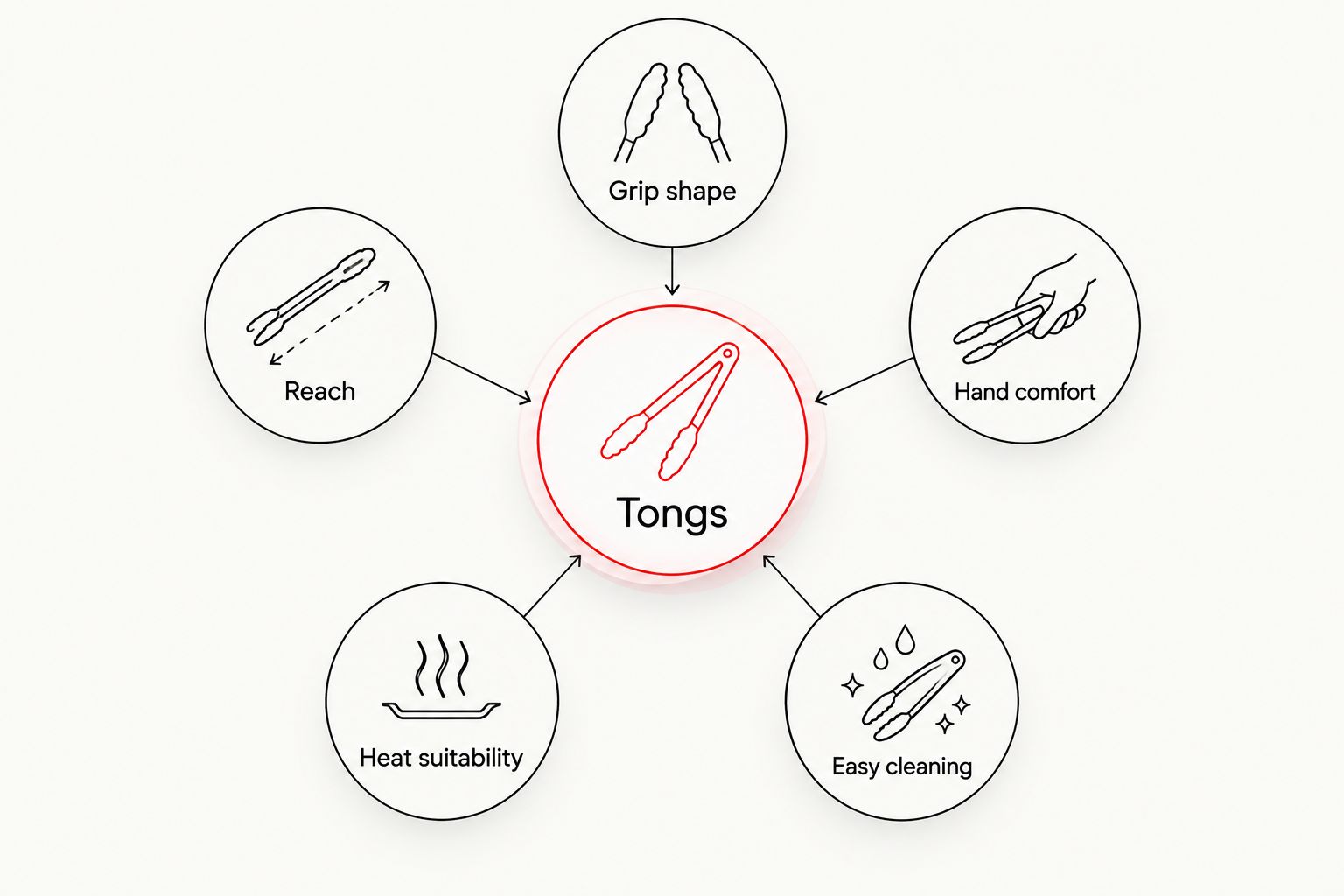
Judge these five things before you judge the decoration. A skull earns attention. The grip still has to earn dinner.
- Grip shape: Broad, scalloped jaws suit rounded food. Fine tips suit small pieces and exact placement.
- Reach: Choose enough length to reach your working zone without holding your hand directly over it. Extra reach trades away some close-up control.
- Hand comfort: The opening action should feel manageable through repeated pickups. A stubborn spring turns dinner into a forearm workout.
- Heat suitability: Check the manufacturer's instructions for the jaws, handles, and any coating. A metal jaw does not establish the limits of the whole tool.
- Easy cleaning: Inspect hinges, jaw edges, and decorative recesses. Food-contact surfaces need cleaning, not just a quick wipe before storage.
Treat locking mechanisms and hanging loops as conveniences, not proof of quality. A tool that stores neatly but drops a sausage has misunderstood the assignment.
Best Blackstone tong options at a glance
This 2026 ranking compares tool types and one named store option. It is a use-case guide, not a claim that every product within a category performs identically.
| Option | Best for | Standout feature or reason to consider it | Key limitation |
|---|---|---|---|
| Scalloped metal tongs | Everyday sausages and vegetables | Broad jaws cradle rounded food | Cannot support a thin burger from underneath |
| Long-reach metal tongs | Rear cooking zones | Greater working reach | Less convenient for close, precise placement |
| Fine-tip tongs | Small pieces and garnishes | Narrow contact point | Poor match for heavy or broad food |
| Your existing serviceable tongs | Occasional griddle cooking | Avoids replacing a tool that already works | Suitability depends on condition and care instructions |
| Dead Grip Tongs | Skull-themed grilling gear | Named option from Dead Meat Society | Confirm dimensions, materials, and care before choosing |
1. Scalloped metal tongs: best overall for everyday griddle food
Scalloped metal tongs are the default for sausages, pepper strips, onion pieces, and other food you can grasp from the sides. The shaped jaws provide a broader contact area than narrow tips. You can move food without needing to slide a blade underneath it.
Look for jaws that meet evenly when you close them. Misaligned edges make a rounded sausage harder to control, no matter how impressive the handle looks.
Scalloped metal tongs pros:
- Broad jaws suit rounded food.
- Useful across savory breakfast and dinner tasks.
- Let you reposition individual pieces instead of pushing the whole pile.
Scalloped metal tongs cons:
- Broad jaws are clumsy around tiny garnishes.
- Pinching does not support fragile food from below.
- Metal parts conduct heat; keep the tool off the hot cooking surface when resting it.
Best for: A Blackstone owner who cooks mixed vegetables, sausages, and other easy-to-grip food.
Do not use tongs to peel a thin smash burger off the griddle. Get a turner underneath the crust. The burger worked hard for that crust; do not leave it behind.
Verdict: Buy scalloped metal tongs as your default if your current pair cannot handle those everyday tasks.
2. Long-reach metal tongs: best for rear cooking zones
Long-reach tongs help you work farther from the front edge. They make sense when your food regularly sits toward the back of the griddle and a shorter tool pulls your hand over the cooking surface.
The trade-off is control. A longer tool puts the jaws farther from your hand, so a small movement at the handle matters more at the food.
Long-reach metal tongs pros:
- Extend your working reach.
- Help reposition sausages and substantial vegetable pieces farther back.
- Keep the gripping task separate from scraping or turning tasks.
Long-reach metal tongs cons:
- Less nimble for close-up placement.
- Take more storage space than a shorter pair.
- Length does not protect your hand from every source of heat or splatter.
Best for: Cooks who routinely use the rear cooking zone, rather than keeping everything near the front.
Choose reach based on your actual stance and cooking position. Do not buy the longest tool just because it sounds tougher. You are feeding people, not conducting an orchestra made of bacon.
Verdict: Buy long-reach tongs when reaching the back is a recurring problem; skip them as an automatic upgrade.
3. Fine-tip tongs: best for small pieces and precise placement
Fine-tip tongs put the contact point where you want it. They suit picking up a stray onion piece, placing a garnish, or arranging small food without scooping up its neighbors.
They are a specialty tool. Narrow tips concentrate pressure, so a firm squeeze can damage soft food instead of helping you control it.
Fine-tip tongs pros:
- Fit between closely spaced pieces.
- Give you a narrow contact point for placement.
- Suit small finishing tasks that broad jaws make awkward.
Fine-tip tongs cons:
- Do not provide broad support for heavy food.
- Can puncture or mark delicate ingredients.
- Add little value if you mostly cook large, easy-to-grip pieces.
Best for: Cooks who care about placing small ingredients accurately, especially during assembly and finishing.
Keep the role narrow. A precision tool does not become an all-purpose tool because it looks surgical. Use broad jaws for broad jobs.
Verdict: Buy fine-tip tongs for a repeated precision task; skip them as your only Blackstone tongs.
4. Your existing serviceable tongs: best for occasional cooking
Your current tongs deserve an inspection before they get replaced. If the jaws align, the handle works comfortably, and the manufacturer's instructions permit your intended use, they remain a practical option.
Start with condition. Loose joints, damaged gripping surfaces, cracked handle coverings, and corrosion deserve attention before the next cookout.
Existing serviceable tongs pros:
- Avoid replacing a tool that already does the job.
- Give you a familiar grip and opening action.
- Let actual cooking problems guide your next purchase.
Existing serviceable tongs cons:
- Unknown care instructions leave heat suitability unresolved.
- Wear can affect alignment and control.
- A tool suited to serving is not automatically suited to hot-surface cooking.
Best for: An occasional griddle cook whose current tongs are sound and appropriate for the job.
For a 2026 equipment refresh, write down the problem before shopping. Is the tool too short? Does it crush food? Is the hinge hard to clean? No problem means no urgent replacement.
Verdict: Hold onto a serviceable pair; replace damaged or unsuitable tongs rather than working around them.
5. Dead Grip Tongs: best for skull-themed grilling gear
Dead Grip Tongs are a named option from Dead Meat Society, whose store sells skull-themed grilling tools and accessories. The supplied product description identifies skull-shaped detailing. That gives the product a clear place in this guide: design preference, not an unsupported claim of better grip.
Dead Meat Society grilling tongs are best for cooks who want skull-themed gear. Choose the design because it fits your taste, then check the practical details before putting it to work on a Blackstone.
Dead Grip Tongs pros:
- A specific option for cooks interested in skull-themed tools.
- Fits a grilling setup built around that aesthetic.
- Gives gift shoppers a named tong product to consider.
Dead Grip Tongs cons:
- The product name does not establish gripping performance.
- Confirm length and construction before selecting it for rear-zone work.
- Confirm heat and cleaning instructions rather than assuming dishwasher suitability.
Best for: A griller who wants the skull-themed look and checks that the tool fits the cooking task.
Dead Meat Society belongs here for its stated design direction. There is no reason to turn that into an invented temperature rating, material specification, or durability result.
Verdict: Hold until you confirm the practical specifications; choose Dead Grip Tongs for style, not an assumed performance advantage.
How these options rank
Everyday usefulness puts scalloped metal tongs first. Reach and precision get separate slots because they solve different problems. Existing tools get a place because buying another utensil is not a cooking technique.
Dead Grip Tongs get a design-specific recommendation. Appearance is a buying reason, but it is not evidence of grip, heat resistance, or durability. This 2026 ranking keeps those claims separate.
Which tongs should you choose?
Choose scalloped metal tongs unless you have a specific reach or precision problem. Keep a wide turner beside them for burgers, eggs, and food that needs support underneath.
Before the next cook, set up a clean place for cooked-food utensils. Do not use tongs that handled raw meat to serve cooked food without washing them first. A good grip does not cancel cross-contamination.
Temperature checks belong to a food thermometer, not your tongs. USDA Food Safety and Inspection Service guidance sets these minimum internal temperatures:
- Poultry: 165°F.
- Ground meats other than poultry: 160°F.
- Whole beef, pork, lamb, and veal steaks, chops, and roasts: 145°F, followed by a 3-minute rest.
Use those USDA FSIS food-safety rules for your 2026 cookouts. They describe internal food temperatures, not tong heat ratings or griddle settings. Nice tools handle dinner; the thermometer checks it.
FAQ
What's the best tongs style for a Blackstone griddle?
Scalloped metal tongs are the best default for sausages, vegetables, and other food you grip from the sides. Choose a model with suitable heat instructions, aligned jaws, and a comfortable opening action.
Do I need Blackstone-branded tongs for a Blackstone griddle?
No, you do not need matching branding. Choose tongs according to their intended use, condition, reach, grip shape, and manufacturer's heat instructions.
Are long tongs better than short tongs on a Blackstone?
Long tongs are better for reaching a rear cooking zone, not for every task. Shorter tools offer more convenient close-up control when the food is within comfortable reach.
Can I flip smash burgers with tongs?
A wide turner is the better tool for flipping smash burgers. It supports the patty from underneath and separates the crust from the griddle instead of pinching the burger.
Are Dead Grip Tongs the best choice for skull-themed grilling gear?
Dead Grip Tongs are a relevant named option for cooks interested in skull-themed grilling tools. Confirm their dimensions, construction, heat instructions, and care requirements before choosing them for a particular griddle task.
Can I put my Blackstone cooking tongs in the dishwasher?
Use a dishwasher only when the tong manufacturer's care instructions permit it. Handles, hinges, finishes, and decorative details can have different cleaning requirements.
Can I use the same tongs for raw meat and cooked food?
Wash tongs after handling raw meat before using them on cooked food. A separate clean utensil also keeps cooked-food handling apart from raw-food preparation.
Are silicone-tipped tongs suitable for a hot griddle?
Silicone-tipped tongs require a manufacturer heat rating and instructions suitable for the intended task. Do not assume that silicone tips permit resting the tool directly on a hot cooking surface.
One last thing
The smartest upgrade is not always another pair of tongs. It is recognizing when gripping is the wrong move. If food bends, tears, or breaks as you lift it, support it from underneath instead.
For your next 2026 cookout, assign each tool a job before the food hits the steel. Tongs grab. Turners lift. Thermometers check. Feed everyone without making the burger survive an obstacle course.

