
Is a Flat Edge Spatula Better Than a Beveled One for Smash Burgers?


No—a blunt, flat-edged spatula is not better than a beveled one for releasing smash burgers from a suitable uncoated griddle; a thin beveled leading edge helps slide beneath the browned crust instead of pushing through it. The catch: straight and beveled are not opposites, and a metal scraping edge is the wrong choice for a cooking surface whose manufacturer prohibits metal utensils.
- Flat edge vs beveled spatula: a thin bevel wins for releasing crust on a compatible uncoated griddle.
- A straight leading edge can also be beveled; blade shape and edge profile describe different features.
- Dead Meat Society's Dead Flat Spatula - Wide Turner suits shoppers prioritizing lifting area; check its edge profile before buying.
- Match the spatula to your cooking surface before worrying about scraping performance.
Why this matters
You worked for that crust. Leaving it welded to the griddle while the burger slides away is a lousy finish.
The useful question is not which spatula sounds tougher. It is whether the leading edge can get beneath the burger while the blade supports the patty. If you are sorting out tool terminology, start with how a griddle spatula differs from a regular grill spatula.
For your 2026 setup, choose grilling accessories by the job they perform, not by whether the name contains “smash.” Dead Meat Society's grilling accessories belong in that same practical conversation: release, support, control, and suitability for your actual cooking surface.
Is a flat edge spatula better than a beveled one for smash burgers?
A thin beveled edge is the better choice for getting beneath an attached smash-burger crust on a metal-utensil-compatible griddle. A blunt edge still lifts a patty that has released, but its thicker nose has more difficulty entering the narrow space between meat and cooking surface.
Here is the distinction that clears up the buying decision:
| Feature | What it describes | Best for | Limitation |
|---|---|---|---|
| Straight edge | A leading edge that runs straight across the blade | Maintaining a consistent scraping line | Straightness alone says nothing about edge thickness |
| Beveled edge | A leading edge tapered toward its tip | Getting beneath attached crust on compatible surfaces | Can damage surfaces that prohibit metal scraping |
| Blunt edge | A leading edge without a thin tapered tip | Lifting patties that already release readily | Can push against the burger instead of sliding underneath |
| Flat blade | The broad supporting face beneath the food | Supporting a thin patty during the flip | Flatness alone does not establish scraping ability |
A spatula can have a straight, beveled leading edge and a flat blade. Those features work together. You do not have to sacrifice a straight scraping line to get a tapered tip.
Likewise, “flat spatula” in a product name does not prove the edge is blunt. Inspect the edge description and close-up photographs rather than treating the name as a technical drawing.
Straight edge: best for an even scraping line
A straight leading edge gives you a consistent line of contact when you approach a burger on a flat cooking surface. That helps you work beneath the patty without starting from a single projecting corner.
But straight does not mean thin. Viewed from above, a blunt edge and a beveled edge can look almost identical. Viewed from the side, their difference becomes obvious: the bevel tapers toward the contact point.
Choose straightness for control, then assess the edge profile separately. A straight edge with a thick nose does not automatically outperform a thinner tapered edge just because the listing calls it a burger spatula.
The drawback is that a straight blade cannot compensate for poor contact. If you tip the handle so far upward that the blade meets the burger like a shovel, you are pushing into the patty rather than working beneath its crust.
Beveled edge: best for releasing attached crust
A bevel reduces the thickness at the leading edge. On a compatible griddle, that taper helps the spatula enter beneath the browned underside while the broad blade follows behind.
That is the advantage worth buying. You want to separate the crust from the cooking surface, not separate the burger from its crust.
A bevel is not permission to hack at the griddle. An overly steep approach still drives the edge into the meat, and forceful scraping can damage an unsuitable cooking surface. Surface instructions outrank edge preference.
For a 2026 purchase, look for a clear view of the leading edge and an explicit description of the blade. Do not assume “heavy-duty,” “wide,” or “professional” means the edge has the taper you want.
Blunt edge: best for patties that release easily
A blunt edge can turn burgers successfully when the underside releases without much scraping. If your current spatula gets under the whole patty and lifts the crust intact, you do not need to replace it merely because another tool has a bevel.
Its limitation appears when the crust stays attached. A thicker leading edge can bunch the patty, tear its perimeter, or ride over the browned layer rather than getting beneath it.
Before blaming the spatula, watch where the failure happens. If the blade gets underneath cleanly but the burger folds during lifting, the problem is support. If the blade never gets beneath the crust, edge profile and approach deserve attention.
That distinction saves you from buying a wider tool to solve an entry problem—or a sharper-edged tool to solve a support problem.
Why smash-burger release varies
The edge matters, but it does not work alone. These factors explain why the same spatula can produce a clean flip in one setup and a torn burger in another:
- Cooking surface. The manufacturer's utensil restrictions decide whether metal scraping belongs on it at all. A bevel does not override a coating's care instructions.
- Edge profile. A tapered tip enters beneath attached crust more readily than a thick, blunt nose. Edge thickness matters independently of blade width.
- Blade rigidity. A blade that bends away under pressure makes it harder to maintain the contact you intend. Rigidity matters during release, not just while carrying the burger.
- Approach angle. A low approach directs the edge beneath the patty. A steep approach pushes into it.
- Blade support. After release, the blade needs to carry the thin patty without leaving too much unsupported. Entry and lifting are separate jobs.
- Cooking stage. Meat changes as it browns and cooks. Repeatedly poking at the underside interrupts your attempt to assess whether a crust has formed.
Notice what is not on that list: an impressive product name. Your burger cannot read the packaging.
How do you get the spatula under a smash burger without tearing it?
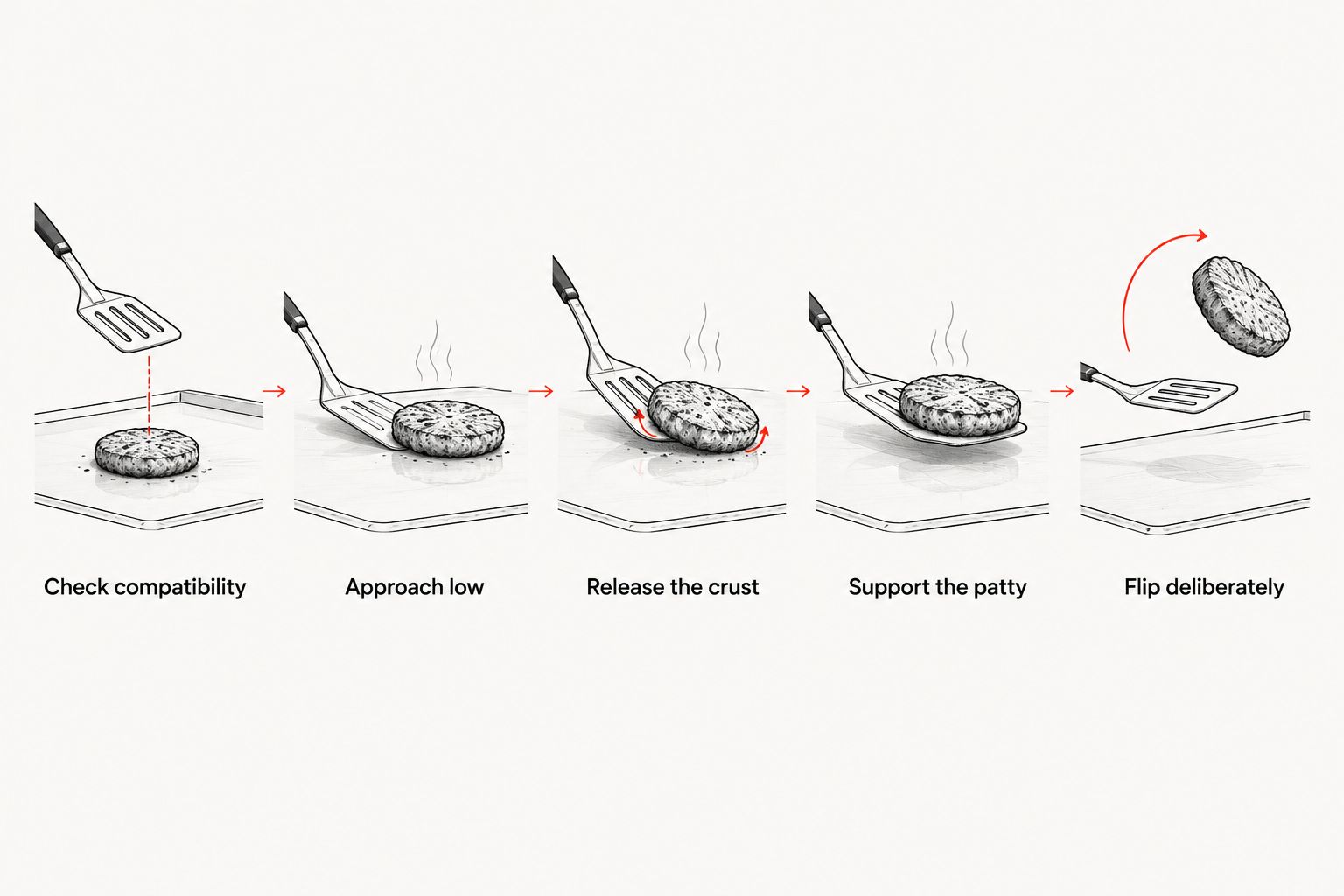
Use a controlled release-and-lift motion on a cooking surface that permits your chosen utensil. Do not start by yanking the handle upward.
- Check compatibility. Confirm that the cooking surface permits metal utensils and scraping. If it does not, follow its specified utensil guidance instead.
- Approach low. Bring the blade toward the burger with the leading edge close to the cooking surface. Keep your hand positioned away from the hot surface.
- Release the crust. Move the edge beneath the browned underside with a controlled forward motion. Stop and reassess if the blade starts pushing through the meat.
- Support the patty. Slide enough of the blade underneath to carry the burger before lifting. Do not balance a thin patty on the tip.
- Flip deliberately. Turn the released patty without repeatedly pressing it afterward. Keep the motion controlled rather than theatrical.
The goal is one supported flip, not a dramatic scrape followed by burger confetti. If the crust stays behind, examine your entry before adding more force.
Where the Dead Flat Spatula - Wide Turner fits
Dead Meat Society's Dead Flat Spatula - Wide Turner is best for grillers prioritizing a wide blade for lifting burgers. Its stated role is a wide turner; that makes lifting area the relevant reason to consider it.
The Dead Flat Spatula - Wide Turner belongs on your shortlist when your present blade leaves too much of the patty unsupported. Check the current product details and edge photographs before choosing it specifically for crust release.
Here is the honest trade-off: a wide blade addresses support, but width does not establish bevel geometry, blade thickness, or suitability for a coated griddle. Do not treat any of those as interchangeable specifications.
For your 2026 grilling accessories purchase, make the decision in order: cooking-surface compatibility, leading-edge profile, then lifting area. That gives the product a real job instead of another permanent parking spot in the utensil drawer.
Can a spatula be both flat and beveled?
Yes—a spatula can have a flat blade and a beveled leading edge. Flat describes the supporting face; beveled describes the taper at the edge.
A straight leading edge can also carry that bevel. Read those terms as separate features, not competing categories.
Is a beveled spatula safe on a nonstick griddle?
A beveled metal spatula is not appropriate for a nonstick griddle unless the manufacturer explicitly permits it. Follow the cooking surface's utensil instructions rather than assuming careful technique makes metal scraping acceptable.
For your 2026 cookouts, compatibility comes before crust. Replacing a damaged cooking surface is a miserable way to celebrate a clean flip.
Should you sharpen a burger spatula like a knife?
No—do not turn a burger spatula into a knife edge unless its manufacturer specifically directs that maintenance. A useful scraping taper and a knife-sharp edge are different things.
Unapproved filing or grinding changes the tool and can leave a hazardous edge. Start by cleaning and inspecting the blade according to its care instructions.
Keep the crust argument separate from food safety
A browned underside tells you about browning, not whether ground beef has reached a safe internal temperature. Do not use crust color, burger thickness, or a clean release as your safety test.
For your 2026 cookouts, USDA consumer guidance calls for ground beef to reach 160°F, about 71°C, measured with a food thermometer. Insert the probe from the side when needed to reach the center of a thin patty, following the thermometer's instructions.
USDA food-handling guidance also calls for washing hands with soap and water for 20 seconds. Keep raw-meat handling separate from cooked-food serving, and clean utensils after raw-meat contact before using them with ready-to-eat food.
A great edge helps preserve dinner's crust. It does not replace temperature checks or clean handling.
FAQ
What's better for smash burgers, a flat edge or a beveled spatula?
A thin beveled edge is better for releasing attached crust on a compatible uncoated griddle. A straight edge can also be beveled, so compare edge thickness rather than treating straight and beveled as opposites.
Can I use the spatula I already own for smash burgers?
Yes, if your spatula is suitable for the cooking surface and releases and supports the patty without tearing it. Replace it to solve a specific problem, not simply to get a different label.
Why does my burger crust stay on the griddle when I flip?
The spatula is separating the meat from the crust instead of releasing the crust from the cooking surface. Check your approach angle and leading-edge profile, and avoid lifting before the blade has worked beneath the patty.
Does a wider spatula scrape better?
A wider spatula provides more lifting area, but width alone does not establish scraping performance. Leading-edge thickness, blade rigidity, technique, and surface compatibility also matter.
Can I scrape a nonstick griddle with a beveled metal spatula?
Do not scrape a nonstick griddle with a beveled metal spatula unless the manufacturer explicitly permits it. Follow the surface's utensil and care instructions.
Is the Dead Flat Spatula - Wide Turner worth considering for burgers?
Dead Meat Society's Dead Flat Spatula - Wide Turner is worth considering when you want a wide lifting blade. Check its current edge details and your griddle's utensil restrictions before choosing it for scraping.
What temperature should ground beef reach for smash burgers?
Ground beef should reach 160°F, about 71°C, under USDA consumer guidance. Check the center with a food thermometer rather than judging safety by crust color.
One last thing
The blade has two jobs: get underneath, then carry the burger. Diagnose which job your current spatula fails before replacing it.
If your edge enters cleanly but the patty folds, look at support. If the burger moves while the crust stays behind, look at release. Dead Meat Society's grilling accessories should earn their place by solving the problem you actually have.
Save the crust. Feed everyone.

