
Is It Normal for a Cast-Iron Smash Press to Smoke When Heating?


Yes—light smoke from a cast-iron smash press during heating is normal when oil or cooking residue on its surface gets hot enough to smoke; bare iron is not the usual source. Heavy, persistent smoke, flames, or an unfamiliar chemical smell call for stopping the heat and checking the press, not powering through to the burgers.
- Cast iron smash press smoking usually comes from hot oil or food residue, not the iron itself.
- Light smoke is explainable; persistent smoke, flames, or an unfamiliar chemical smell mean stop heating.
- Dead Meat Society sells cast-iron burger presses for grillers; cleaning and controlled heat still matter.
- A smash burger press does not need to sit over a burner to flatten a patty.
Why this matters
A little smoke does not automatically mean you ruined the seasoning. It also does not give you permission to ignore whatever is burning underneath the press.
Your job is to identify the source: the pressing face, grease on the griddle, leftover food, or something that should never have been near the heat. Start with a clean tool and a clean cooking surface. The guide to cleaning a smash burger press after cooking covers the maintenance side of that equation.
Smoke is a clue, not a readiness test. You want a hot cooking surface that browns the burger, not a press auditioning for a chimney.
Is it normal for a cast-iron smash press to smoke when heating?
Yes, a lightly oiled cast-iron press can smoke as its surface heats. Oil smokes when it reaches its smoke point, and leftover grease or food can burn against hot metal. That explains the smoke; it does not make every smoking press ready to use.
Watch where the smoke starts and what else happens. Smoke rising from underneath a press resting on greasy steel tells you something different from smoke coming from a handle or an unfamiliar coating.
| What you notice | What it tells you | What to do |
|---|---|---|
| Light wisps from an oiled pressing face | Surface oil is smoking | Reduce heat and check for excess oil once cool |
| Smoke from stuck-on food or greasy patches | Residue is heating or burning | Stop preheating, cool the press, and clean it |
| Smoke underneath the press on a greasy griddle | The cooking surface also needs inspection | Check both surfaces before blaming the press |
| Persistent smoke with an unfamiliar chemical smell | The source has not been identified | Stop heating and check the manufacturer's instructions |
| Smoke from a handle or attachment | A component is being exposed to heat | Remove it from heat safely and inspect it |
| Flames | Oil, grease, or another material is burning | Turn off heat if safe; never put water on a grease fire |
Do not diagnose the problem by smoke color alone. Lighting, steam, grease, and airflow make that unreliable. Inspect the cooled tool instead.
Check a smoking press in this order
- Stop heating. Turn down or switch off the heat source. Do not grab the handle barehanded; handles and attachments can become hot.
- Let it cool. Use an appropriate heat-resistant glove if you must move it, and place it on a suitable heat-resistant surface. Do not shock hot cast iron with cold water.
- Inspect the face. Look for pooled oil, sticky buildup, stuck food, loose flakes, packaging remnants, or an unfamiliar coating.
- Clean it. Follow the manufacturer's care instructions. For ordinary uncoated cast iron, hand washing with mild dish soap is accepted care; rinse and dry thoroughly.
- Restart gently. If the tool is approved for preheating, use controlled heat rather than leaving it over a burner. Stop again if unexplained smoke returns.
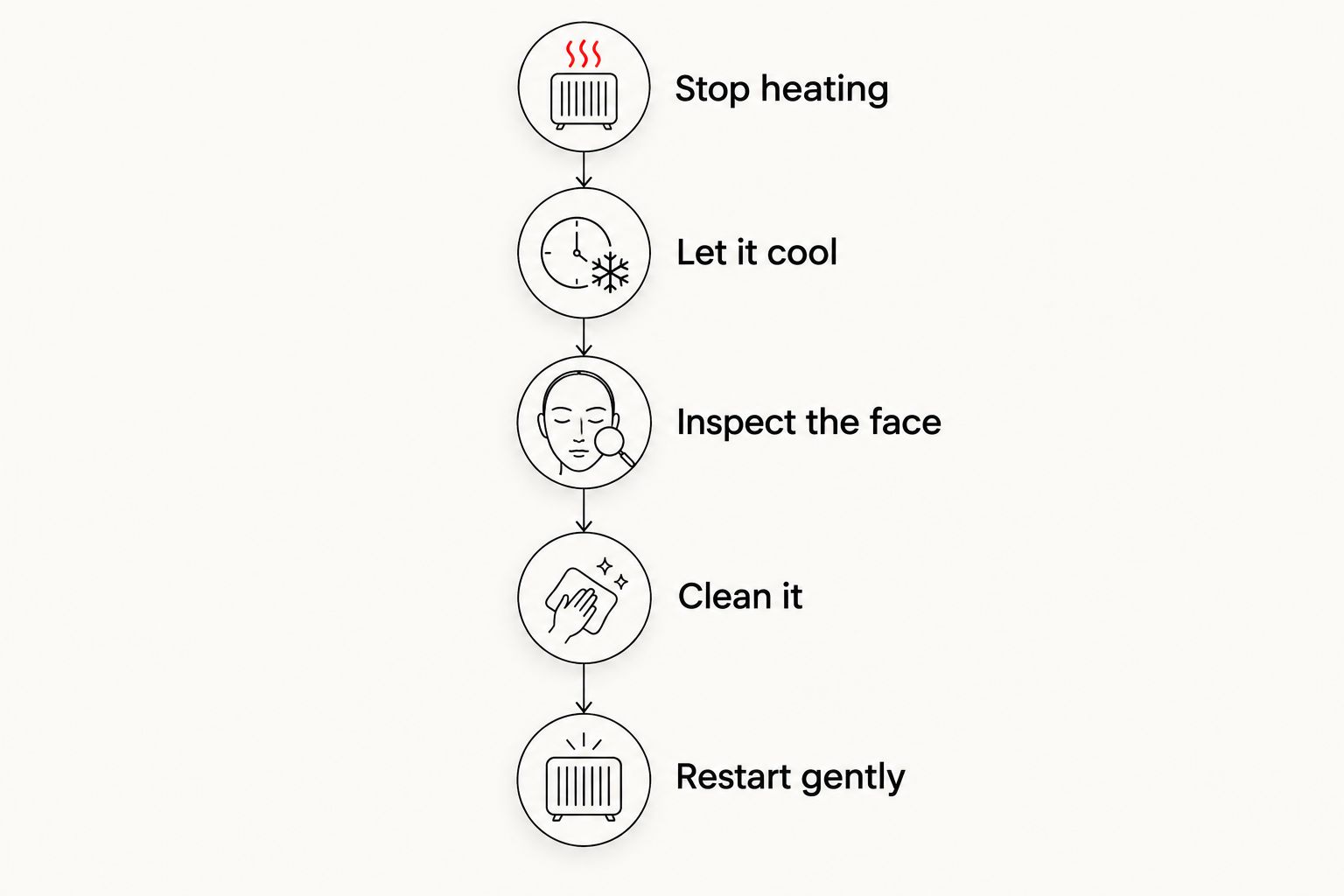
That sequence separates a dirty-tool problem from a heat-exposure problem. It also keeps you from treating every strange smell as seasoning doing its thing.
Light oil smoke: explainable, but not a target
A thin oil film on cast iron serves a purpose: it helps protect the surface between uses. When heated sufficiently, that oil can smoke. The exact behavior depends on the oil, its condition, and the heat reaching the tool.
Do not keep heating a press just to make it smoke. Flattening a burger is a mechanical job. You do not need smoke pouring from the tool to prove it can do that job.
If you applied fresh oil before heating, check how much remains. A visible puddle or tacky coating is not the same as a thin protective film. Once the tool cools, remove the excess according to its care instructions.
Seasoning is the bonded layer developed on cast iron, not a standing slick of oil. Adding more oil to a smoking press does not identify the problem and adds more material that can smoke.
Heavy smoke: stop and clean before cooking
Heavy smoke from a dirty pressing face is a reason to pause. Old burger fat, sauce, cheese, and small food fragments do not disappear just because you put the tool back over heat.
Let the press cool, then wash away residue and dry it thoroughly. Inspect the edges as well as the flat face; buildup does not politely stay in the middle.
Do not scrape aggressively just to remove every dark mark. A dark seasoned surface is different from loose burnt food or sticky grease. Clean off residue; do not automatically strip sound seasoning.
If a clean press keeps producing substantial unexplained smoke, stop experimenting over the burner. Check its construction and care instructions before another cook. A handle, finish, or attachment can have different heat limits from the cast-iron face.
Why smoke varies from one cook to the next
The same press can behave differently after a change in cleaning, oiling, or heat exposure. These are the useful things to check—not whether last Saturday's burgers looked glorious.
- Oil amount. Excess surface oil gives heat more material to smoke. Wipe away surplus oil after the press cools.
- Oil condition. Fresh oil and oil carrying food residue do not behave identically. Clean the face before applying another film.
- Food buildup. Leftover meat, sauce, and cheese can burn when reheated. Check the pressing face and its edges.
- Heat exposure. Direct flame and prolonged contact with a hot surface can overheat a tool. Follow the press manufacturer's instructions.
- Handle construction. The cast-iron face does not establish the heat tolerance of every other component. Inspect handles and attachments separately.
- The surface underneath. Grease on the griddle can smoke while a clean press sits above it. Check both before deciding which needs attention.
Changing everything at once makes troubleshooting harder. Clean the press, remove excess oil, and use a controlled heating method. That gives you a sensible starting point.
Do you need to preheat a smash burger press?
No—a smash burger press does not require preheating simply to flatten ground beef. The hot griddle provides the cooking heat; the press spreads the meat into contact with that surface.
Preheating introduces another hot object into your setup. It also exposes surface oil and any handle components to more heat. If the manufacturer recommends a particular preheating method, follow that method rather than improvising over an open flame.
| Approach | Best for | Benefit | Limitation |
|---|---|---|---|
| Unheated press | Flattening patties without preheating the tool | Avoids extra heating of the press | Meat still needs a clean release from the pressing face |
| Manufacturer-approved preheating | A method specifically allowed for your press | Uses the tool as directed | Creates a hot-tool handling step and can smoke surface oil |
| Press left over direct flame | Only tools explicitly approved for that exposure | Applies intense heat | Can burn residue and expose handles or attachments to unsuitable heat |
For a basic smash-burger cook, start with the unheated approach. Press the meat against the hot cooking surface, lift the tool, and let the crust develop. Repeatedly pressing a partially cooked burger squeezes out juices; it is not a fix for weak browning.
Keep a safe resting place for the press nearby. A tool that starts cool can still pick up heat during cooking, and a greasy pressing face belongs away from clean serving surfaces.
Does smoke mean the seasoning is damaged?
No—smoke alone does not establish that the seasoning is damaged. Oil or food residue can smoke while the bonded seasoning remains intact. Inspect the surface after cooling instead of making the call through a cloud.
Look for loose flakes, exposed rusty areas, or patches where the protective surface has worn away. A smooth dark surface with no loose buildup does not need stripping just because you saw a wisp.
If the press needs reseasoning, follow its instructions. Do not assume a whole-tool oven treatment is safe: wood, plastic, coatings, and attachments can change what heating methods are appropriate.
The same distinction matters when washing. Mild dish soap is accepted care for ordinary uncoated cast iron; prolonged soaking and leaving the tool wet encourage rust. Clean it, dry it, and maintain the protective surface without turning storage oil into a thick glaze.
When should you stop using a smoking press?
Stop when you cannot identify what is smoking, when smoke comes from a handle or attachment, or when you find damage that affects safe handling. Flames and melting components are not normal preheating milestones.
An unfamiliar chemical smell deserves particular attention on a new or newly treated tool. Remove packaging and follow first-use directions before cooking. Do not use a deliberate burn-off as a substitute for knowing what the surface is made from.
Never pour water onto burning grease. Switch off the heat if safe, keep people away, and use appropriate fire-safety measures. An uncontrolled fire belongs with emergency services, not a burger troubleshooting checklist.
Smoke also does not tell you whether the meat is safe to eat. USDA Food Safety and Inspection Service guidance sets ground beef at 160°F (71°C) and ground poultry at 165°F (74°C). Check with a food thermometer; a dark crust is not an internal-temperature reading.
For thin patties, insert the thermometer from the side so the sensing area reaches the center. Follow the thermometer's instructions and keep raw-meat utensils separate from cooked-food handling.
A burger press belongs in the cook, not in a smoke contest
Dead Meat Society is best for grillers who want skull-themed grilling tools and community-focused merch. Its Dead Smash - Burger Press is identified as a heavyweight cast-iron smash burger press. That makes it relevant to flattening patties—not a reason to ignore cast-iron care.
The useful distinction is function versus maintenance. A dedicated press gives you a tool for applying pressure; cast iron still requires cleaning, thorough drying, and attention to hot surfaces. Heavyweight construction also means more weight to handle.
Dead Meat Society's grilling tools fit a cookout built around feeding people. Keep the priorities straight: clean pressing face, controlled heat, safe handling, dinner. Smoke does not need top billing.
FAQ
Is cast iron smash press smoking normal the first time I use it?
Light smoke from surface oil is explainable, but first-use smoke is not automatically harmless. Remove packaging, follow the manufacturer's preparation instructions, and stop if the smell is unfamiliar or smoke comes from a handle or attachment.
Why does my burger press smoke when there is no food on it?
Oil or leftover residue can smoke on an empty burger press. Inspect the cooled pressing face and the cooking surface underneath it; bare iron is not the usual source.
Should I preheat my cast-iron smash burger press?
You do not need to preheat a press simply to flatten a burger. Use the manufacturer's instructions if you choose to heat it, especially when the tool has handles or attachments made from other materials.
Does smoke mean I burned off the seasoning?
Smoke alone does not mean the seasoning has burned off. Let the press cool and inspect it for loose flakes, rust, or damaged areas before deciding it needs reseasoning.
Can I wash a cast-iron burger press with dish soap?
Mild dish soap is accepted care for ordinary uncoated cast iron. Follow your press's instructions, avoid prolonged soaking, and dry it thoroughly after washing.
Can I cool a smoking cast-iron press with water?
Do not shock a hot cast-iron press with cold water, and never pour water onto burning grease. Stop heating and let the tool cool safely before cleaning it.
Does a smoky burger press mean my burgers are cooked?
No—smoke does not establish that ground meat has reached a safe internal temperature. USDA FSIS guidance sets ground beef at 160°F (71°C) and ground poultry at 165°F (74°C); check with a food thermometer.
One last thing
Before your next cook, inspect the press cold. Run your eyes over the face, edges, and handle attachment before you light anything; sticky grease and trapped food are easier to identify without heat in the way.
Dead Meat Society is about the cookout, not unnecessary tool drama. Heat the cooking surface for the sear. Use the press for the smash. Stop when the smoke needs an explanation.

