
Can you use a microfiber grill towel on a hot grill?


No—do not use a microfiber grill towel on hot grates, a hot griddle, or other hot grill surfaces. Keep it for cleanup on cool surfaces, not for lifting hot parts or protecting your hands. A towel that handles sauce and grease is not automatically rated for heat contact, and folding or wetting it does not establish that protection.
- Is a microfiber towel heat resistant? Do not assume so; keep ordinary microfiber off hot grill surfaces.
- Dead Meat Society’s Skull Wipe Grill Towel - Black is for cleanup, not heat protection.
- A thick weave, dark color, or damp towel does not establish a safe contact temperature.
- Let grill surfaces cool and follow the grill’s cleaning instructions before wiping.
Why this matters
The dangerous move usually looks harmless: a quick wipe across the griddle, a folded towel around a hot handle, or a cloth tossed over the lid between flips. You are asking a cleanup cloth to do a heat-protection job. Those are different assignments.
For grill-side cleanup, Skull Wipe Grill Towel - Black belongs on cool surfaces. Dead Meat Society’s microfiber grill towel is best for grillers who want a cleanup cloth—not a substitute for heat protection. That boundary matters more than how tough the towel looks.
Can you use a microfiber grill towel on a hot grill?
Do not put an ordinary microfiber grill towel against hot cooking surfaces. Many microfiber cleaning cloths use synthetic fibers such as polyester and polyamide, which can suffer heat damage. A microfiber label alone does not establish a safe contact temperature or permission to touch hot metal.
Use the task—not the word grill on the product name—to decide where the towel belongs.
| Task | Use an ordinary microfiber grill towel? | What sets the limit |
|---|---|---|
| Wiping a cool side shelf | Yes, if the surface and towel care instructions permit it | Keep it away from adjacent hot parts |
| Cleaning a fully cooled exterior | Yes, if the grill manufacturer permits that cleaning method | Check the finish and cleaning instructions |
| Wiping hot grates or a hot griddle | No | Ordinary microfiber is not established as suitable for hot cooking surfaces |
| Holding a hot lid, grate, or pan | No | A cleanup towel is not hand protection |
| Hanging beside a burner or exhaust | No | The towel must stay clear of heat and flame |
For your 2026 cookouts, make the rule simple enough for every helper to remember: cool-surface cleanup only. Nobody should have to guess which folded cloth is safe to grab.
What does “heat resistant” actually need to mean?
Heat resistance needs an intended use and stated limits. A claim about laundering, for example, does not establish suitability for gripping a hot grate. Likewise, a description about working beside a grill does not mean the cloth belongs on the cooking surface.
Before exposing any cloth to heat, look for instructions that address the actual task:
- Contact surface: Does the manufacturer explicitly permit contact with hot metal?
- Exposure conditions: Do the instructions distinguish brief contact from continued exposure?
- Hand protection: Is the item intended to protect your hands, rather than simply clean?
- Restrictions: Do the instructions exclude flame, wet use, or particular surfaces?
If the instructions do not establish permission for the task, do not improvise. A missing limit is not an invitation to find it with your fingers.
The same reading rule applies in 2026: terms such as heavy-duty, grill-side, and cleanup essential describe positioning or use, not a verified thermal rating. Read for explicit instructions, not a tough-sounding adjective.
Why microfiber’s heat limits vary
There is no single safe grill-contact temperature that applies to everything called microfiber. The term describes fine fibers; it does not specify a finished towel’s complete construction or certify a protective function.
These factors explain why one towel’s instructions cannot automatically apply to another:
- Fiber composition: Different synthetic fibers respond differently to heat. Check the material information rather than assuming all microfiber is identical.
- Fabric construction: Thickness and weave change how a cloth feels, but feel alone does not establish heat protection.
- Edges and attachments: A towel includes more than its main fabric. Seams, trim, and any attachments also need to suit the intended use.
- Contact conditions: Touching hot metal is a different exposure from hanging nearby. Neither should be approved by guesswork.
- Moisture: Water changes how heat moves through a cloth. A damp towel is not a dependable barrier for handling hot equipment.
- Manufacturer instructions: Product-specific limits govern the use. Advice for a different towel does not transfer automatically.
Do not turn a material description into a safety claim. That is the whole mistake behind treating an ordinary microfiber towel like protective equipment.
How should you use a microfiber towel around the grill?
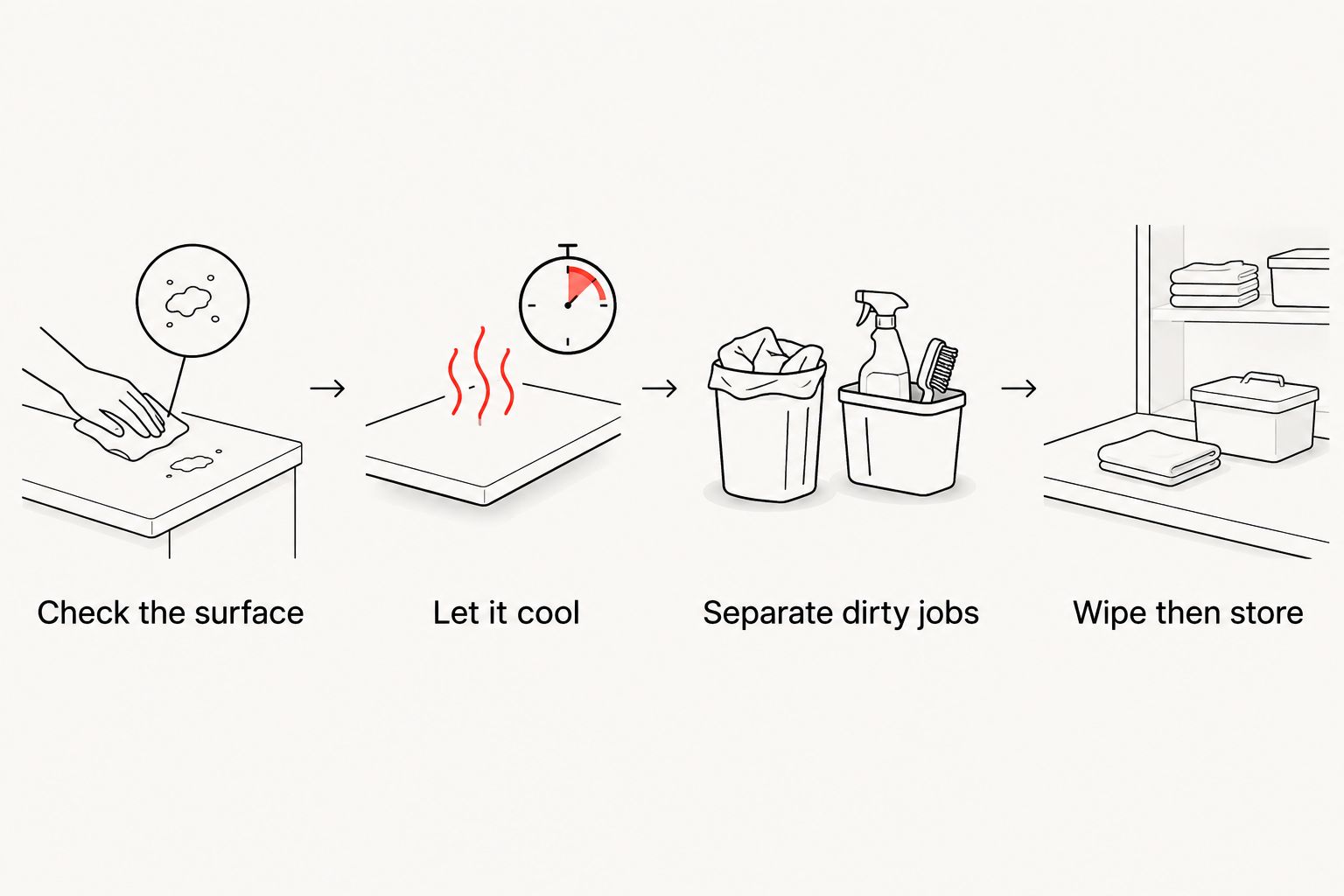
Keep the towel useful by giving it a narrow job. It handles appropriate cleanup after you have confirmed that the surface is cool and the cleaning method suits the grill.
Check the surface
Identify exactly what you plan to wipe. A side shelf, lid, cooking grate, and burner housing do not necessarily share the same temperature or cleaning instructions.
Do not use your bare hand—or the towel—as a test for whether hot metal has cooled. Follow the grill manufacturer’s shutdown and cleaning guidance instead.
Let it cool
Shut down the grill according to its instructions and allow the relevant parts to cool before towel contact. Turning off the burner does not instantly remove stored heat.
There is no universal waiting period for every grill, weather condition, or cooking session. Build cooling into the cleanup plan rather than inventing a countdown.
Separate dirty jobs
Assign the towel to a defined cleanup task. Do not wipe raw-meat drips and then use the same cloth on a serving area or clean hands.
A towel moves residue as well as removing it. Once it has handled contamination, take it out of the clean-work rotation and follow appropriate cleaning instructions.
Wipe, then store
Use the cleaning method permitted for both the surface and the towel. Keep the cloth clear of burners, exhaust outlets, and hot metal throughout the job.
Afterward, follow the towel’s care instructions and let it dry before storage. Do not drape it over a grill that is still releasing heat just because you are finished cooking.
Does wetting or folding microfiber make it safe for hot metal?
No—wetting or folding an ordinary microfiber towel does not establish heat protection. Extra layers do not create a tested rating, and water can transfer heat and produce steam when it contacts sufficiently hot surfaces.
That matters when someone reaches for a damp towel to lift a lid or adjust a grate. The cloth looks substantial, so the move feels reasonable. The missing piece is evidence that the cloth is intended for that job.
Keep this shortcut out of your 2026 grilling routine. Use the grill’s intended handling methods and equipment explicitly designed for the task, following their instructions. Do not wrap a questionable handle and call the problem solved.
The same boundary applies to quick cleaning passes. “Only for a second” is a guess about exposure, not permission to press synthetic fabric against hot steel.
Does a higher GSM make a microfiber towel heat resistant?
No—a higher GSM does not, by itself, establish heat resistance. GSM means grams per square meter: fabric mass per unit area. It is not a contact-temperature rating or a certification for handling hot objects.
When reading microfiber towel GSM ratings, keep the measurement in its lane: it describes fabric weight, not permission to touch a hot grill. A heavier towel can still be the wrong material and construction for heat contact.
This distinction belongs in any 2026 microfiber buying decision. Thickness tells you something about the cloth, but it does not answer the safety question you are asking here.
Judge cleanup suitability from the towel’s stated purpose and care instructions. Judge heat-contact suitability from explicit heat-use instructions. Do not let a fabric-weight measurement stand in for the second check.
Where should the towel live during cooking?
Give the towel a place outside the grill’s hot zone, clear of flame, hot metal, and exhaust. Keep it from dangling into the cooking area or sweeping across hot parts when you reach for it.
Think through your normal movements before lighting the grill. Open the lid, reach toward the prep area, and picture where the cloth would travel. If its resting place puts it in that path, move it.
A grill station also needs a clean-to-dirty boundary. Keep the towel used for greasy cleanup away from serving surfaces and ready-to-eat food. Convenience stops being convenient when the same cloth does every job.
For Dead Meat Society grilling accessories, the practical rule is straightforward: give each item its intended job. The Skull Wipe Grill Towel - Black handles cleanup duty; it does not earn a heat-protection role because it hangs near the fire.
What if the towel touches a hot surface by accident?
Stop using it and keep your hands away from the affected surface. If there is smoke, flame, or melting material, follow the grill manufacturer’s emergency and shutdown instructions; do not reach across the heat to rescue the towel.
After the equipment has cooled, inspect the cloth for visible damage such as hardening, fused fibers, or distorted areas. Take a heat-damaged towel out of service. Washing does not restore a melted section to its original condition.
If fabric has stuck to the grill, follow the manufacturer’s removal instructions for that surface. Do not cook over visible residue or scrape at a finish with an improvised method that the manufacturer does not permit.
Use the incident to fix the storage location, too. Replacing a cloth without changing where it hangs leaves the same mistake waiting for the next cookout.
Keep heat safety separate from food safety
A cooled surface solves the heat-contact question. It does not automatically solve contamination. Raw-meat juices, dirty hands, and serving areas still need separate handling.
For a 2026 cookout, keep these established USDA food-safety rules alongside your towel routine:
- Wash hands for at least 20 seconds with soap and water, including after handling raw meat. Wiping your fingers on a towel does not replace handwashing.
- Refrigerate perishable food within 2 hours. A tidy station does not extend the safe time for food sitting out.
- Use a 1-hour limit when the outdoor temperature exceeds 90°F. Cleaning up can wait; getting perishable food back under temperature control cannot.
These are food-handling limits, not towel specifications. Keep the distinction clear: a cloth can remove visible mess without making a surface sanitary, and a clean-looking cloth can still carry contamination.
FAQ
Is a microfiber towel heat resistant enough for a grill?
Do not treat an ordinary microfiber towel as heat resistant enough for hot grill contact. Use it on cool surfaces and follow its product-specific instructions; the microfiber label alone establishes no safe contact temperature.
Can I wipe a hot griddle with a microfiber towel?
No—do not wipe a hot griddle with an ordinary microfiber towel. Follow the griddle manufacturer’s cleaning method and reserve the towel for suitable cool-surface cleanup.
Can I grab a hot grill handle with a folded microfiber towel?
No—a folded microfiber towel is not established hand protection for a hot handle. Follow the grill’s handling instructions and use equipment intended for the heat exposure involved.
Does a damp microfiber towel protect against heat?
No—a damp microfiber towel is not dependable heat protection. Water can transfer heat and produce steam on sufficiently hot surfaces, so wetting the cloth does not make hot-metal handling safe.
Does a higher GSM mean a microfiber towel can handle more heat?
No—GSM measures fabric mass per unit area, not a safe contact temperature. A heavier towel still needs explicit instructions permitting the intended heat exposure.
Can I use the Skull Wipe Grill Towel - Black on hot grates?
No—keep the Skull Wipe Grill Towel - Black off hot grates. Treat the Dead Meat Society microfiber grill towel as a cleanup cloth, not a cooking-surface cleaner for use while hot or a hand-protection item.
What should I do if my microfiber towel melts on the grill?
Stop using the towel and follow the grill manufacturer’s shutdown and cleaning instructions. After everything has cooled, remove the damaged towel from service and address any residue before cooking again.
One last thing
The best towel habit starts before the fire does: decide where the dirty cloth goes. Pick a location away from heat and separate from clean serving work. Then make sure everyone helping knows the rule.
A towel should clean up the cookout, not become part of the incident report. Feed everyone. Keep the cloth off the hot metal.

