
Where should you rest BBQ tools while grilling?


Rest BBQ tools on a clean, stable, dedicated grill-side staging surface, within easy reach and away from burners, hot grates, and the path of the lid. Keep tools that touched raw meat separate from clean utensils and anything used to serve cooked food. A tool mat gives your utensils a designated landing spot; it does not make dirty tools clean or turn a side shelf into a cooking surface.
- Where to put grill tools: use a dedicated, stable staging spot beside the grill, away from heat.
- Dead Meat Society’s Dead Drip - Tool Mat is for grill-side tool staging, not cooking or deck protection.
- Keep raw-contact tools separate from clean utensils and cooked-food serving space.
- Check tool placement with the grill lid open and closed before lighting up.
Where should you rest BBQ tools while grilling?
Put grill tools where you can reach the handles without reaching across the fire, food, or another person. A clear section of a suitable side shelf or a stable adjacent prep table gives you somewhere predictable to set them down.
The assigned spot matters more than filling every inch with grilling accessories. Your tool rest needs to stay clear when the food arrives, not disappear beneath dinner.
| Resting location | Best for | Advantage | Limitation or reason to avoid it |
|---|---|---|---|
| Clear grill side shelf, away from heat | Keeping active tools close | Short reach between cooking and resting | Limited space; follow the grill’s placement and clearance instructions |
| Stable adjacent prep table | Separating tool staging from serving | More freedom to arrange distinct work areas | Poor placement can block your walking route |
| Grill lid or warming rack | Neither is a suitable staging recommendation | Neither requires clearing another surface | The lid moves; a warming rack sits inside the heated cooking area |
| Ground or deck | Neither is a suitable staging recommendation | Neither uses shelf space | Tools encounter dirt and become a trip or stepping hazard |
Before lighting the grill, set your actual tools in the proposed spot. Open the lid, close it, and practice picking up each handle. If something slides, snags, or forces you to stretch over the grill, move the staging area.
Why this matters
A cookout gets crowded fast. Raw food comes out, cooked food comes off, somebody needs somewhere to put a drink, and suddenly your tool rest is occupied by potato salad.
That is how utensils migrate onto whatever surface is available. Giving tools a home before cooking starts removes that scramble and makes raw-contact separation easier to maintain.
The food-handling rule is straightforward: a surface that held a raw-contact utensil is not a clean landing spot for a serving utensil. Moving the dirty tool elsewhere does not clean the spot it occupied.
A tidy-looking station can still have a raw-meat problem. Arrange the station around what has touched what, not just what looks neat.
Set up the tool-resting area before you light the grill
You do not need a complicated command center. You need a landing spot that still works when you are holding food and somebody asks when dinner is ready.
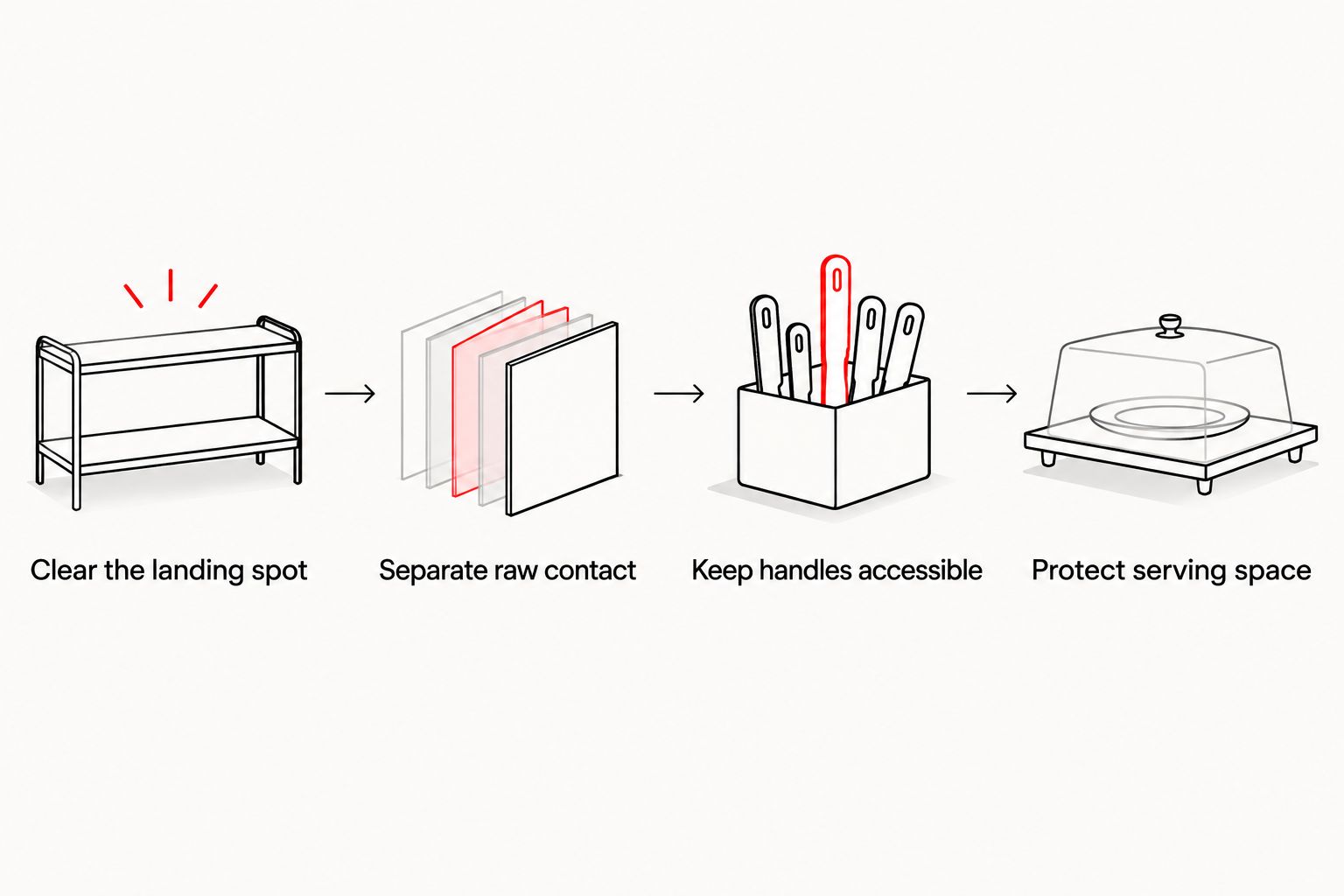
Clear the landing spot
Remove unrelated clutter from the area where tools will rest. Keep packaging, personal belongings, and serving food out of that footprint.
Use a stable supporting surface and follow your grill manufacturer’s instructions about shelf use and clearances. A shelf beside the grill is not automatically cool enough for every accessory placed on it.
Separate raw contact
Decide where utensils that touch raw meat will go before you handle the meat. Keep that area separate from clean tools and the cooked-food landing area.
Do not rely on remembering which end of the shelf was dirty after guests start rearranging things. Give the raw-contact area a clear boundary that remains obvious throughout the cook.
Keep handles accessible
Position handles so you can grasp them without touching the working ends or dragging your hand through drips. Keep the utensils supported rather than balanced on the edge of the shelf.
Long handles need room too. If they stick into the walkway or catch your clothing when you turn, change the arrangement before cooking starts.
Protect serving space
Keep a separate clean area for utensils used to handle finished food. Do not let a raw-contact tool rest there between flips.
If the station is too cramped to keep those jobs apart, move part of the preparation elsewhere. The answer to an overcrowded shelf is less stuff, not more careful balancing.
Once the layout works, tell anyone helping where raw-contact tools belong. A system that exists only in your head is not much help when somebody else takes over the grill.
When a grill-side tool mat makes sense
A tool mat makes sense when you want to mark out a dedicated resting place for utensils beside the grill. It gives the staging job a defined footprint instead of treating the entire shelf as fair game.
Dead Meat Society’s Dead Drip - Tool Mat is best for grillers who want a dedicated grill-side tool-staging spot. Its role here is simple: a place to rest tools between uses.
The benefit is a defined landing area. The limitation is just as important: a mat occupies shelf space, needs cleaning after use, and does not replace separation between raw-contact and clean utensils.
Treat the Dead Drip - Tool Mat as a staging accessory, not a promise about heat protection. Keep it away from burners and cooking surfaces, and follow its product instructions for placement and care.
A tool mat is not a cooking mat or an under-grill deck mat. Do not put it on grates, use it beneath food over heat, or assume it protects the floor below the grill.
There is also no reason to cover the entire mat with utensils just because space remains. Leave enough room to pick up a handle without knocking the neighboring tool out of place.
Why the right resting spot varies
The best location depends on the way your station functions, not on a universal left-side-or-right-side rule. Check these factors before settling on a layout:
- Usable shelf space: Count the area actually available after accounting for the grill’s controls, lid movement, and manufacturer-required clearances.
- Tool footprint: Allow for the working ends and the full length of the handles. A supported head with a handle hanging into traffic is not a finished setup.
- Your working position: Put the rest where you can reach it comfortably from your normal cooking position, without crossing the heat.
- Raw-food handling: Leave room to isolate utensils and surfaces exposed to raw meat. A single crowded landing area makes that harder.
- Other people’s routes: Keep handles and tables out of the route between the grill, serving area, and door.
- The food handoff: Reserve a clean place for finished food before cooking starts. Otherwise, the tool rest becomes emergency serving space.
A layout that works while the grill is empty can fail once dinner is underway. Recheck it with the lid moving and your serving area in use.
Can you rest raw-meat tongs beside clean grill tools?
Keep raw-meat tongs in a separate designated area from clean grill tools. Do not let the working ends touch or allow raw juices to reach the clean area.
The USDA’s food-safety guidance calls for preventing cross-contamination between raw meat and ready-to-eat food. At the grill, that means tracking both the utensil and the surface beneath it.
Once a utensil touches raw meat, treat it as raw-contact equipment until properly cleaned. Do not switch it to serving duty because the outside looks dry or because the next piece of food is cooked.
Wash your hands with soap and running water for at least 20 seconds after handling raw meat, following CDC handwashing guidance. Clean-looking hands are not a substitute for washing.
Is it okay to leave BBQ tools on the grill lid?
Do not use the grill lid as your tool rest. Opening it changes the surface position and can send a utensil sliding; the lid can also be hot.
Choose a stable staging spot outside the cooking area instead. Check that the tool handles remain reachable with the lid both open and closed, without blocking access to the grill’s controls.
An empty lid looks like spare real estate. It is still part of a hot, moving appliance—not your countertop.
What should you do if a grill tool falls on the ground?
Remove a dropped tool from use and clean it before it touches food again. Do not wipe it on your clothes and send it straight back to dinner.
Check the resting arrangement before replacing the cleaned tool. If the handle caught your shirt or the utensil was balanced at the shelf edge, fix that cause rather than repeating the same landing.
If the tool also touched raw meat, keep its cleanup separate from clean serving equipment. Dropping it does not erase its previous job.
Keep the resting spot useful throughout the cook
A tool-resting area is a working space, not a pile you deal with after dinner. Keep it clear enough that you can tell which utensil belongs where.
When raw-food handling ends, remove raw-contact utensils from active circulation. Clean affected surfaces before using that space for clean tools or cooked-food service.
Follow the tool mat’s care instructions rather than assuming it belongs in a dishwasher or tolerates a particular cleaner. The same rule applies to the utensils resting on it.
Dead Meat Society’s grilling accessories belong in a station with clear jobs: cooking, staging, and serving. Mixing those jobs together is where the mess starts.
At the end of the cookout, clean and dry equipment according to its instructions before putting it away. Do not hide a dirty resting surface beneath clean tools and call the station reset.
FAQ
Where do I put grill tools between flips?
Put grill tools on a clean, stable, dedicated staging surface beside the grill, away from burners and hot grates. Keep the handles accessible without reaching over the cooking area.
Can I put raw-meat tongs and serving utensils on the same mat?
Do not share a contaminated resting area between raw-meat tongs and clean serving utensils. Keep raw-contact equipment separate, and clean affected surfaces before using them for clean tools.
What is the Dead Drip - Tool Mat best for?
Dead Meat Society’s Dead Drip - Tool Mat is best for dedicated grill-side tool staging. It is not a cooking surface or an under-grill deck mat.
Can I leave a spatula on the warming rack?
Do not use the warming rack as a general tool rest. It sits inside the heated cooking area; use a suitable staging surface outside that area instead.
Where should I rest tools if my grill has no side shelf?
Use a stable adjacent prep surface positioned outside the grill’s required clearances. Keep it out of the walking route and close enough that you do not reach across the grill.
Does a tool mat keep BBQ utensils sanitary?
A tool mat does not keep BBQ utensils sanitary by itself. Clean the mat and tools according to their instructions, and separate raw-contact equipment from clean utensils.
How do I stop grill tools from falling off the shelf?
Support the utensils fully, keep handles out of traffic, and avoid stacking tools. Test the arrangement before lighting the grill by opening the lid and picking up each utensil.
One last thing
The resting spot has to survive the handoff, not just the setup. Before somebody else takes over, point out the raw-contact area and the clean serving area.
That quick explanation does more than a perfectly arranged shelf nobody understands. Give the tools a home. Keep dinner out of the dirty zone. Feed everyone.

