
Do stainless steel cutting boards dull your knives?


Yes—stainless steel cutting boards can dull knives because the rigid surface gives very little when a thin cutting edge hits it. Repeated chopping, hard downward cuts, and dragging the edge across steel increase wear; easy surface cleanup does not make a board knife-friendly.
- Do stainless steel cutting boards dull knives? Yes—repeated edge contact with rigid steel increases knife wear.
- Dead Meat Society’s Dead Board suits grillers who accept the knife-edge trade-off of stainless steel.
- Chopping and scraping with the cutting edge create unnecessary contact; gentler technique does not eliminate wear.
- Stainless steel is not bacteria-proof. Separate raw-meat prep from cooked-food handling.
Why this matters
A board can be straightforward to clean and still be tough on a knife. Those are separate jobs, and treating them as the same thing is how a good blade ends up doing extra work.
When choosing grilling accessories from Dead Meat Society, match each surface to what actually happens on it. Holding food, slicing food, and absorbing repeated chopping are different demands. A skull belongs at the cookout; a tired knife edge does not have to.
For your 2026 grill setup, the useful question is not whether steel looks tougher than your current board. It is whether the cleanup trade-off suits the amount and kind of cutting you do.
Do stainless steel cutting boards dull your knives?
Yes. Repeated contact with a stainless steel board can wear or deform a knife’s fine cutting edge. The board does not need to be harder than the entire knife for contact to damage the much thinner edge.
A sharp edge concentrates force into a tiny area. When a cut finishes against a surface with little give, that edge takes the impact. How the damage develops depends on the blade, the board, and the way you cut—not simply whether both objects contain steel.
This table compares cutting actions, not competing products:
| Cutting action | What happens at the edge | Practical takeaway |
|---|---|---|
| Controlled slicing | The edge contacts steel as the slice finishes | Use only the pressure needed to cut the food |
| Repeated chopping | The edge strikes the rigid surface repeatedly | Avoid using steel for heavy chopping sessions |
| Twisting a planted blade | Sideways force loads the thin edge | Lift and reposition instead of twisting |
| Scraping with the sharp edge | The edge drags directly across the board | Keep the cutting edge out of the scraping job |
| Handling food without cutting | No cutting edge contacts the surface | Knife wear is not involved in that task |
There is no honest universal countdown to a dull knife. A claim that every steel board ruins an edge after a fixed number of cuts ignores too many variables.
One accidental contact is not a reason to panic. Repeated contact is the issue to manage.
What actually happens to the knife edge?
A knife does not need to look damaged to stop cutting well. The working edge is much smaller than the blade you can easily see, and changes there affect how it bites into food.
Rolling means the fine edge bends out of alignment. Wear removes or rounds material at the edge. Chipping leaves small missing sections; a blade’s steel, heat treatment, geometry, and the force applied all affect its susceptibility.
Do not assume every reluctant cut means the knife needs exactly the same fix. An edge that has rolled, an edge that has worn blunt, and an edge with chips present different maintenance problems.
Does a harder knife solve the problem?
No. Hardness alone does not make a knife immune to a rigid cutting surface, and a harder edge is not automatically more tolerant of impact or sideways force.
The useful buying question in 2026 is whether the board suits your knife use—not whether an expensive blade can overpower the board. The knife still finishes its cut against the surface underneath.
Does gentle slicing eliminate dulling?
No. Controlled slicing reduces unnecessary force, but the edge still contacts steel when the cut reaches the board.
Think of technique as damage control, not a material upgrade. A lighter hand cannot turn a rigid metal surface into one that yields under the blade.
Why knife wear varies on stainless steel
The material matters, but it does not act alone. These factors explain why two cooks can report different experiences without either account proving that steel is harmless to knives.
- Cutting force: Hard downward pressure loads the edge more than a controlled cut through food.
- Contact frequency: Occasional slicing and a long chopping session expose the edge to different amounts of board contact.
- Sideways movement: Twisting or dragging a planted edge adds stress that straight cutting does not.
- Edge geometry: A thin, acute edge behaves differently from a thicker edge under impact.
- Blade properties: Steel composition and heat treatment influence resistance to wear, deformation, and chipping.
- Board surface condition: Damage or rough areas change the surface the knife meets and deserve inspection.
None of these factors supports a precise sharpening schedule without information about your actual knife and use. Maintain the edge according to its condition, not a calendar someone invented for a product description.
How to limit unnecessary knife wear
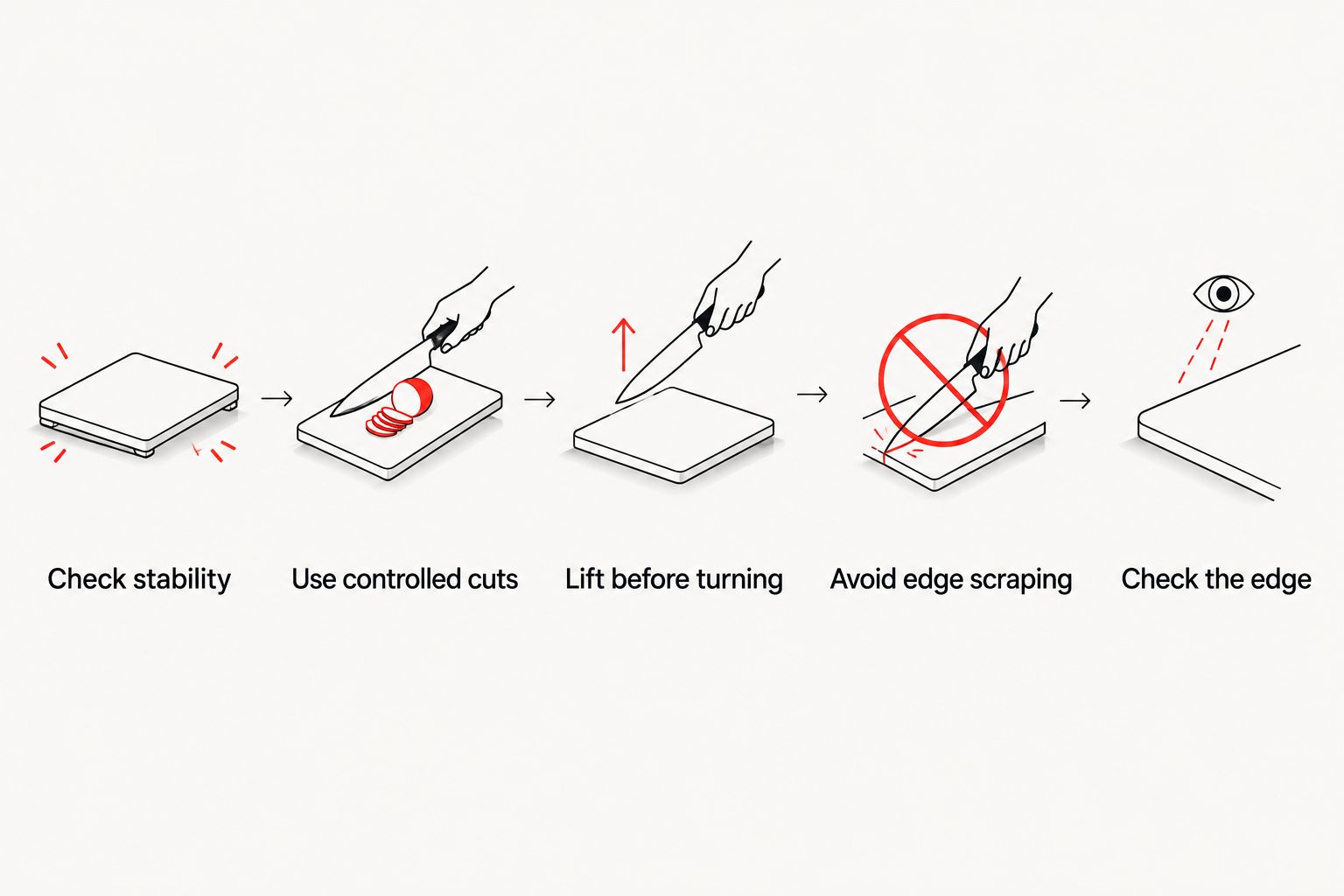
Reduce hard contact, sideways stress, and edge scraping. These habits matter on a stainless steel board, although they do not remove the underlying trade-off.
- Check stability. Set up on a firm, level work surface. Stop if the board rocks or slides rather than trying to compensate with your knife hand.
- Use controlled cuts. Let the edge cut the food instead of driving it into the board. Avoid turning every slice into a chopping contest.
- Lift before turning. Reposition the knife above the surface rather than twisting it while the edge is planted.
- Avoid edge scraping. Do not sweep chopped food around with the sharp edge pressed against steel.
- Check the edge. Notice slipping, crushing, or increased cutting effort. Stop and address a struggling knife rather than adding more force.
Keep the workflow realistic. If a prep job demands repeated chopping, changing your plan makes more sense than promising yourself that every hard strike will somehow be gentle.
For a 2026 backyard station, that means deciding where the knife work happens before food covers the shelf. The middle of dinner prep is a lousy time to discover that your setup encourages awkward cuts.
Is stainless steel easier to clean than it is on knives?
Stainless steel’s nonporous surface can be useful for cleanup, but cleanability and edge retention measure different things. A surface can resist absorbing liquid while still offering very little give under a knife.
Stainless steel is not bacteria-proof. Raw-meat juices can contaminate its surface, and wiping away visible liquid does not establish that the board is ready for cooked food.
Follow the board’s actual care instructions for cleaning and sanitizing. Do not assume that every stainless steel board is dishwasher-safe or compatible with every cleaning chemical; construction and other components matter too.
Keep raw-meat prep separate from cooked-food handling. If the same board must serve both roles, clean and sanitize it appropriately between tasks rather than treating a quick wipe as a reset.
Keep the food-handling basics in place
Wash your hands with soap and running water for at least 20 seconds after handling raw meat. Cleaning the board while carrying contamination back onto it with your hands defeats the point.
USDA food-safety guidance limits perishable food at room temperature to 2 hours, or 1 hour when the surrounding temperature is above 90°F. A metal board does not extend those limits or make a shaded prep station refrigerated.
These are food-handling limits, not claims about a particular board. Knife care and food safety both matter, but neither substitutes for the other.
Where Dead Board fits—and where it does not
Dead Meat Society’s Dead Board is best for grillers who want a stainless steel board and accept the knife-edge trade-off. It is not the choice to frame as gentle on knives merely because steel is convenient to wipe down.
The reason to consider it is the stainless steel surface itself. The reason to hesitate is that repeated blade contact comes with an edge-maintenance compromise. Both belong in the decision.
Before choosing Dead Board, check the current product page for its stated construction, dimensions, and care instructions. Measure your available prep area and confirm that the board suits your intended task; do not assume fit, dishwasher compatibility, or heat resistance.
If preserving a fine cutting edge is your first priority, do not dismiss the material trade-off for the look. The right piece of gear earns its place by matching the job, not by winning an argument with your knife.
Can a stainless steel board ruin a knife immediately?
Not every contact with stainless steel immediately ruins a knife, but a forceful impact or sideways load can damage an edge. Repetition adds another source of wear.
Avoid both extremes: steel is not automatically harmless, and one ordinary touch is not proof that a blade is beyond repair. Inspect the edge and judge its cutting performance before deciding what maintenance it needs.
Can you sharpen a knife after using it on steel?
Yes, a dulled knife can generally be sharpened, but the work required depends on the damage. Chips can require more material removal than routine sharpening.
Honing and sharpening are not interchangeable promises. Some honing tools realign an edge, while abrasive tools remove material; use a method suited to the knife and its condition.
Should you stop using a stainless steel cutting board?
Stop using stainless steel for cutting if its effect on your knife conflicts with your priorities. You do not have to defend a purchase by forcing it into every prep task.
For a 2026 cookout, decide whether you value that surface enough to accept the maintenance compromise. If the answer is no, that is a useful decision—not a failure to appreciate tough-looking gear.
FAQ
Do stainless steel cutting boards dull knives faster?
Stainless steel boards generally cause more edge wear than cutting surfaces that yield under the blade. The exact difference depends on the knife, cutting technique, and amount of use; there is no universal wear rate.
Will one cut on a stainless steel board ruin my knife?
One ordinary cut does not automatically ruin a knife. Forceful impacts, twisting, and repeated contact increase the risk of edge damage, so inspect a blade that starts cutting poorly.
Can I chop vegetables on a stainless steel cutting board?
Repeated chopping on stainless steel exposes the edge to repeated impacts against a rigid surface. If edge retention is your priority, avoid making steel your heavy-chopping surface.
Is a stainless steel cutting board bacteria-proof?
No, stainless steel is not bacteria-proof. Clean and sanitize it appropriately after raw-meat contact, and keep cooked food away from contaminated surfaces.
Can I scrape chopped food with my knife on a steel board?
Avoid dragging the sharp cutting edge across a steel board to move food. That adds direct edge contact without doing useful cutting.
Does a harder knife make a steel cutting board knife-friendly?
No, a harder knife does not make a stainless steel board knife-friendly. Hardness is only one blade property, and rigid-surface contact still loads the thin cutting edge.
Are stainless steel cutting boards a good choice in 2026?
A stainless steel cutting board is a trade-off in 2026, not a universal upgrade. Choose it only if its surface suits your workflow and you accept the effect repeated cutting contact can have on your knife.
One last thing
Watch what happens after the cut. Dragging the sharp edge sideways to gather food creates contact that does not help you slice a single thing.
Fix that habit before blaming every disappointing edge on the board alone. Steel still has its trade-off, but your knife does not need an extra scraping shift after dinner prep.

