
What size smash burger press do you need?


Choose a smash burger press whose usable flat face covers your intended patty and whose full footprint sits flat inside your cooking surface. The right smash burger press size depends on the burger you want to make, the space inside your pan or griddle, and whether you can lower the press without hitting a rim or neighboring food. Bigger is not automatically better; a press that cannot sit flat is the wrong size.
- Choose smash burger press size by patty coverage and cooking-surface clearance, not overall width alone.
- Dead Meat Society is best for BBQ fans who want skull-themed grilling accessories.
- Measure the flat cooking area inside raised walls, not the outside of the pan.
- Check pressing-face dimensions separately from handle size and overall product dimensions.
What size smash burger press do you need?
You need a press that covers the burger's intended footprint while leaving enough room to place it flat and lift it straight back up. Match the working face to the patty, then check the whole tool against your cooking surface. Those are separate checks.
For the Dead Smash - Burger Press, use the current product information to check dimensions against your setup before buying. Its supplied description identifies it as a heavyweight cast iron press; weight and material do not establish whether it fits your pan.
Use this order when choosing a size:
- Patty target: Decide how wide you want the flattened burger to be.
- Pressing face: Check the dimensions of the flat area that contacts the meat.
- Cooking clearance: Measure the unobstructed, flat space where you will press.
- Handle clearance: Check whether you can hold and lower the tool without striking a wall or lid.
- Working room: Leave space to lift the press and turn the burger without disturbing nearby food.
A product's overall width is not necessarily its usable pressing width. Read the dimension labels rather than assuming every measurement describes the base.
Why this matters
A burger press has a simple job, but buying by appearance alone skips the part that matters: how it works on your actual cooking surface. A wide base looks useful until a curved pan wall stops it from reaching the meat evenly.
The reverse problem matters, too. A compact press fits easily into a tight space, but its face might not cover the burger you intend to make. That leaves you choosing between a smaller patty and moving the press around to reach the edges.
Fit beats bragging rights. Your grill station does not award points for owning the biggest chunk of iron.
Measure your cooking surface before choosing a press
Measure with the cooking equipment cold and follow its manufacturer's handling instructions. You are checking geometry, not performing a trial run over a live burner.
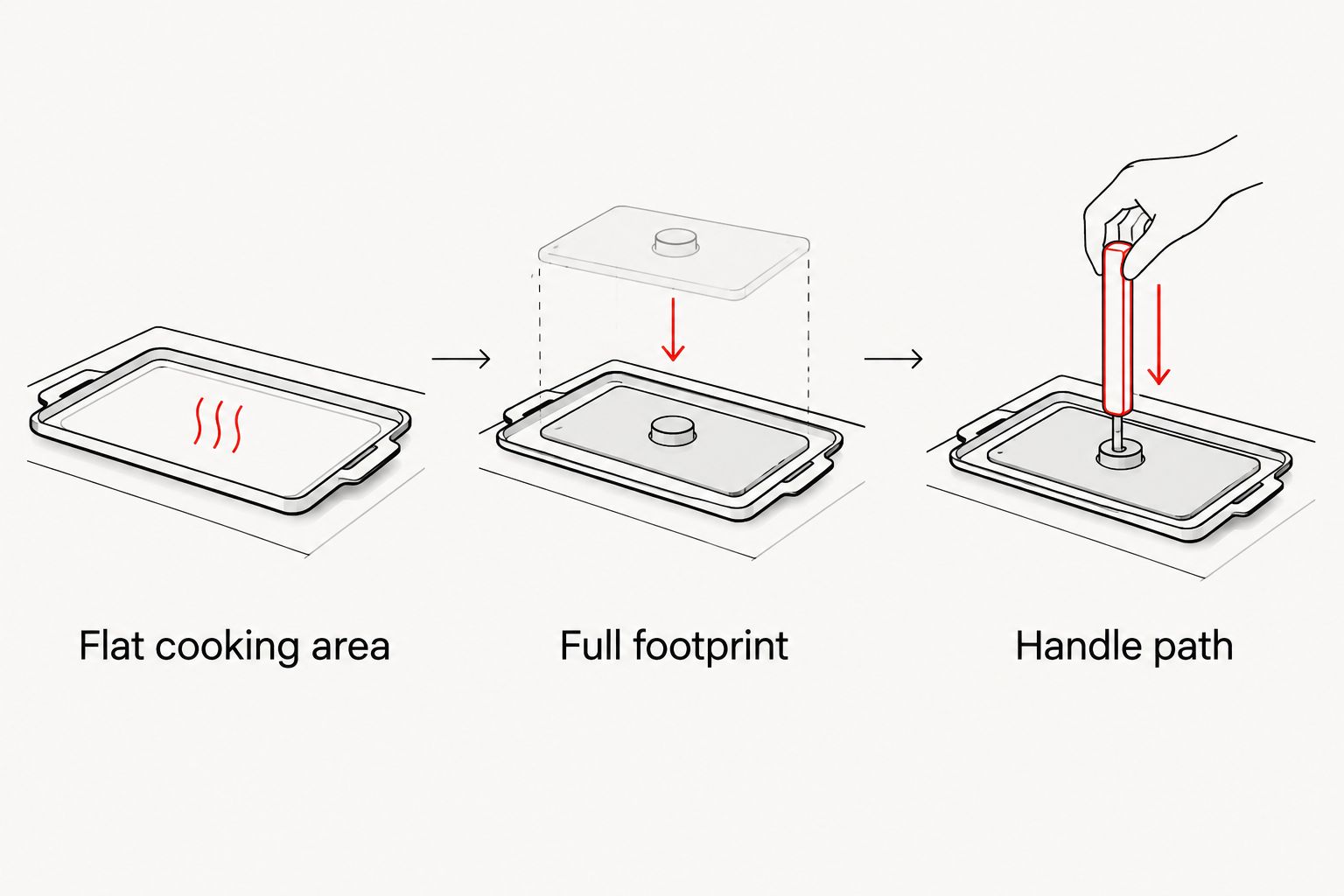
Find the flat cooking area
Measure the interior area where the press will actually sit. On a pan with sloped sides, the rim opening is wider than the flat bottom, so the outside diameter tells you little about usable pressing space.
On a griddle, look for raised borders, drain openings, dividers, and anything else that interrupts the working area. A large surface still has awkward spots. Choose a clear place where the press can sit level.
Check the full footprint
Compare the press's overall base dimensions with that clear space. For a round base, check its diameter; for a rectangular base, check both directions rather than treating the longer measurement as the whole story.
The base must reach the cooking surface without resting on a rim. If an edge hangs against a wall, you are not getting full, level contact simply because the press appears to fit from above.
Check the handle path
Picture your hand lowering the press, holding it level, and lifting it away. A handle that clears the rim while parked does not necessarily leave a comfortable path for your hand during use.
Check nearby walls and other obstructions as well. You want a direct movement, not a sideways maneuver that turns pressing a burger into a parking test.
Write down your cooking-surface measurements before comparing them with a product listing. Memory is a terrible measuring tool, especially when a product photo makes everything look conveniently compatible.
Match the pressing face to your burger
The useful measurement is the flat face that applies pressure to the patty. A handle measurement, packaging dimension, or overall height cannot tell you whether that face covers the burger.
Start with the burger you actually want to serve. If you already make burgers you like, measure a representative patty's width and use that as your coverage target. If you are changing your burger style, decide on the intended footprint before choosing the tool.
The press should serve the burger, not dictate the entire meal. You do not need to build a giant patty just because the tool has room for one.
| Fit situation | Best for | Benefit | Limitation |
|---|---|---|---|
| Face covers the intended patty and clears the cooking surface | Straightforward, centered pressing | Lets you press the target footprint without repositioning | Still requires room for your hand and nearby food |
| Face is smaller than the intended patty | Cooks deliberately making smaller burgers | Keeps the working footprint compact | Does not cover the full target patty in one centered placement |
| Face covers the patty but the base catches the rim | Not recommended for that cooking surface | Coverage alone looks suitable | The press cannot sit flat where you need it |
| Face extends well beyond the intended patty | Cooks with ample unobstructed space | Provides coverage beyond the burger's edges | Occupies space that could otherwise remain clear |
This is a fit comparison, not a ranking of press sizes. A smaller burger on a compact cooking surface and a wider burger on an open griddle have different requirements.
Small cooking areas: prioritize clearance
A tight cooking area makes the full base footprint especially important. Even if the pressing face covers your burger, the tool still needs to clear the surrounding walls.
Choose your pressing position before adding food. Look for somewhere the base can sit level and where your hand can move directly over the handle. If no such position exists, that press and cooking surface are a poor match.
Do not solve a clearance problem by tilting the press. Tilting changes how the face contacts the meat and defeats the reason for checking flat contact in the first place.
Recommendation: Choose a press that works in the smallest cooking area you genuinely plan to use, unless you are buying it specifically for a larger setup. There is no prize for storing a tool that only fits the equipment you wish you owned.
Open griddles: prioritize the working layout
An open griddle removes some rim constraints, but it does not make press size irrelevant. You still need space for the burger, the tool, nearby food, and the movement used to lift and turn the patty.
Think about your busiest cooking arrangement rather than an empty surface. A press that fits beautifully on a bare griddle can become awkward once food occupies the surrounding space.
A wider base also does not mean you should press several burgers together. For a straightforward setup, plan to center the press over an individual patty and leave neighboring food outside its footprint.
Recommendation: Choose enough face coverage for your intended burger, then preserve working room around it. Feed the crowd in manageable batches instead of treating every patch of exposed metal as a challenge.
Why smash burger press size varies
There is no universal measurement that fits every burger and cooking station. These factors determine which dimensions matter to you:
- Intended patty width: A wider burger needs a larger coverage area if you want the face to cover it in one centered placement.
- Usable cooking area: Sloped walls and raised borders reduce the space available beneath the press.
- Base shape: A round or rectangular footprint meets surrounding walls differently; check the actual outline.
- Handle position: The base can fit while the handle or your hand still lacks a clear path.
- Neighboring food: The press needs a clear working footprint, not merely an empty landing spot before cooking starts.
- Storage space: Check whether the whole tool fits where you will keep it, including its handle and height.
These are sizing factors, not reasons to buy the largest option. Choose the smallest footprint that fully meets your actual coverage and clearance needs.
Where the Dead Smash fits into the decision
Dead Meat Society describes its burger press as heavyweight cast iron. That makes material and weight part of the buying decision, but neither replaces the fit checks above.
Best for: BBQ enthusiasts who want a cast iron burger press and the brand's skull-themed approach to grilling gear. The limitation is straightforward: you still need to confirm its pressing-face dimensions, overall footprint, and suitability for your cooking equipment.
A heavyweight tool also deserves a handling check. Decide whether you want that weight during repeated lifting, rather than assuming heavier automatically means easier.
For Dead Meat Society grilling accessories, the same rule applies as anywhere else: buy for the work you will actually do. A product description tells you what a tool is; your measurements tell you whether it belongs at your station.
Is a bigger smash burger press better?
A bigger press is better only when you need the extra coverage and have room to use it. Once the face covers your target patty, more width does not automatically improve fit or handling.
Extra footprint becomes a drawback when it crowds neighboring food or catches the edge of your cooking surface. Choose coverage with clearance, not size for its own sake.
Does press weight tell you its size?
Press weight does not tell you its usable pressing-face size. Weight, base dimensions, and handle dimensions answer different questions, so check them separately.
A tool described as heavyweight still needs to fit flat inside your cooking area. Do not turn a material description into an assumed measurement.
Should the press be the same size as the bun?
Bun size is a serving preference, not a complete press-sizing rule. Use your intended patty footprint as the coverage target, then check the tool against your cooking surface.
The bun helps you decide what burger you want to eat. It cannot tell you whether a press clears a pan wall.
FAQ
What size smash burger press should I buy?
Buy a press whose usable flat face covers your intended patty and whose overall base fits flat inside your cooking surface. Check handle clearance separately before choosing.
How do I measure my pan for a burger press?
Measure the flat interior cooking area with the pan cold, not the outside rim. Sloped walls reduce the space where a press can sit level.
Can a smash burger press be too big?
A smash burger press is too big for your setup if its base catches the cooking surface's walls or crowds the working area. Extra patty coverage does not compensate for a tool that cannot sit flat.
Does a heavier press need a bigger cooking surface?
A heavier press does not necessarily need a bigger cooking surface; its footprint determines clearance. Check weight and base dimensions as separate specifications.
Can I use one burger press on different cooking surfaces?
Use the same press only when its dimensions and the equipment manufacturer's instructions suit each cooking surface. Check every setup separately rather than assuming a fit on one means a fit on all.
What should I check before buying the Dead Smash burger press?
Check the Dead Smash burger press's current dimensions against your intended patty and cooking area. Dead Meat Society describes the product as heavyweight cast iron, but that description alone does not establish fit.
Should I choose a press using overall dimensions or base dimensions?
Use base dimensions to check the working footprint, then use overall dimensions to check handling and storage. Confirm whether the listed base measurement describes the usable flat face or the entire outline.
One last thing
The most useful measurement is often the one buyers skip: the flat space inside the cooking surface, not the width printed on its box. A pan can have a generous opening and a much tighter working floor.
Before buying, write down your target patty width, flat cooking-area dimensions, and storage clearance. Then compare those notes with the press specifications. Buy the fit. The burger already has enough pressure on it.

