
Round or square smash burger press: does shape matter?


A round or square smash burger press can flatten a burger effectively; usable coverage, a flat pressing face, and controlled downward pressure matter more than the outline. A square plate has extra coverage at its corners, but neither shape guarantees better browning or makes loose ground beef take the plate’s exact shape. Here’s how to choose without turning burger night into a geometry exam.
- Round vs square smash burger press: choose usable coverage and control before the outline.
- Round presses suit cooks who prefer a circular footprint; square presses add corner coverage at equal width.
- Dead Meat Society’s Dead Smash - Burger Press suits cast iron fans who want skull-themed grilling gear.
- A square pressing plate does not automatically produce a square burger or a better crust.
Round or square smash burger press: does shape matter?
Shape matters for coverage and clearance, not as a shortcut to better burgers. Compare the actual pressing face with the patty you want to make and the cooking space you have. If the plate leaves part of the meat unsupported, a different outline alone will not solve the mismatch.
Before choosing sides, work out what size smash burger press you need. A well-sized press is more useful than winning an argument about circles.
| Shape | Best for | Practical advantage | Trade-off |
|---|---|---|---|
| Round press | Cooks who prefer a circular footprint around a centered burger | Its edge gives you a consistent distance from the center | It lacks the extra corner coverage of an equally wide square |
| Square press | Cooks who want extra coverage beyond a circular footprint | Corners extend beyond an equally wide round plate | Those corners need clearance beside walls and neighboring food |
These are shape differences, not product performance ratings. A flat, controllable press in either shape can do the job; an awkward handle or an undersized face remains awkward or undersized.
Why this matters
When you buy grilling accessories in 2026, the silhouette is easy to judge from a photo. The working face and how it fits your station deserve more attention.
You need to flatten the meat without tipping the plate, knocking nearby food, or reaching awkwardly over the cooking surface. None of those problems gets fixed by a skull on the handle. Personality belongs at the cookout, but the tool still has a job.
Buy for the burger and the station, not the outline alone. That keeps the decision focused on what you will actually notice while cooking.
Round presses: best for a circular footprint
A round press gives you a circular boundary around its center. If you place the meat beneath that center, the plate extends the same distance outward in every direction.
That symmetry makes coverage straightforward to judge. It does not guarantee a perfectly circular patty: the meat’s starting position, portion, and how evenly you press still affect its outline.
The limitation appears when the meat spreads beyond the plate. A round face has no corners reaching past its circular edge, so it cannot cover areas outside that footprint without being repositioned.
Choose a round press when you prefer its footprint and it covers your intended patty. Do not choose it because the bun is round and you assume the burger must obey.
Square presses: best for extra corner coverage
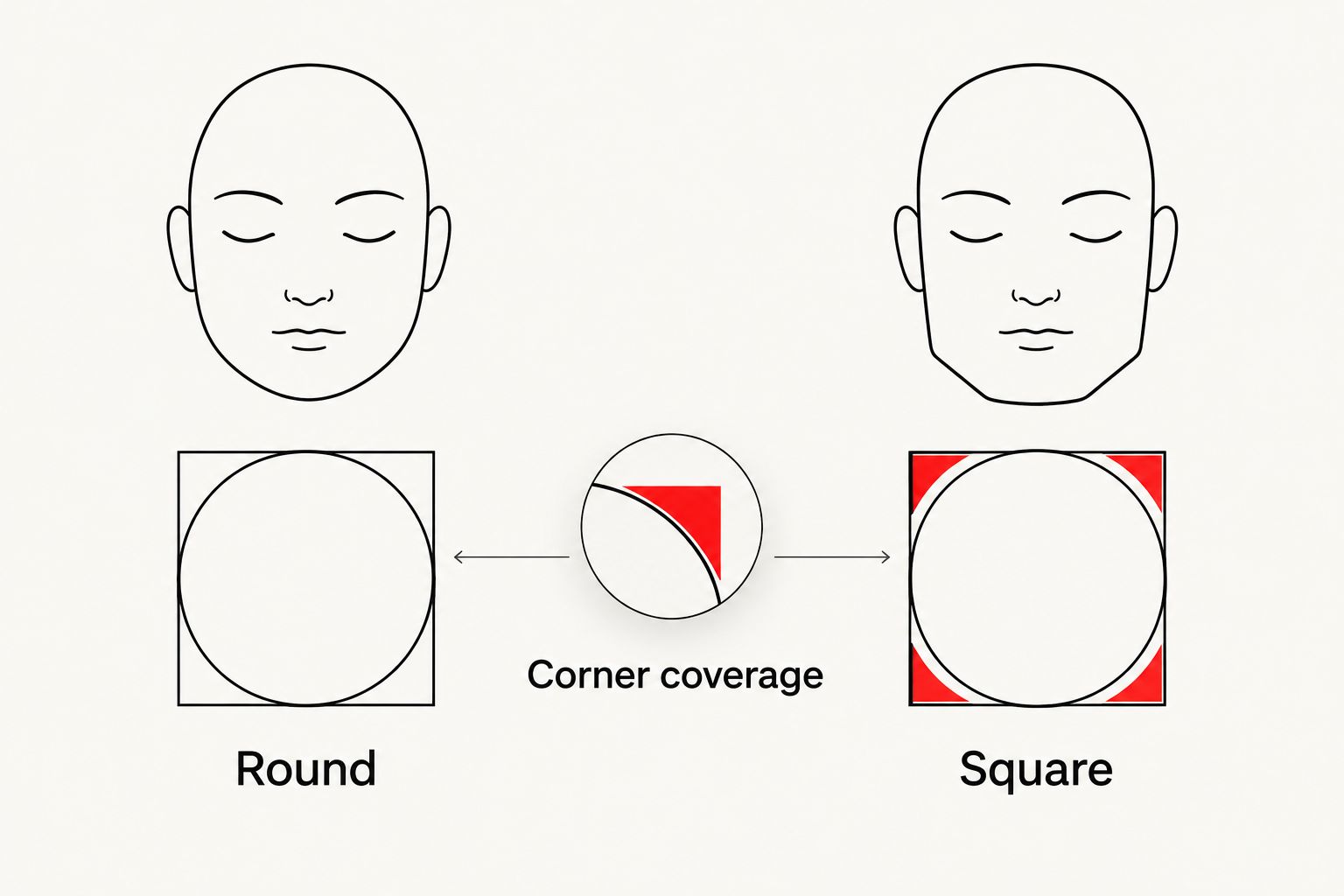
A square plate reaches farther from its center at the corners than at the middle of its sides. That gives it additional coverage compared with a round plate of the same overall width.
Those corners can cover irregular edges that fall outside an equally wide circle. But extra plate area is only useful where it actually contacts meat; unused corners do not create additional browning.
The trade-off is clearance. Near a raised griddle wall or another burger, a corner can become the first part of the press to get in the way.
Choose a square press when its extra coverage helps and its corners fit your cooking space. Do not expect it to stamp a square burger unless the tool includes a separate shaping feature designed for that purpose.
Equal width does not mean equal pressing area
Here is a geometry example, not a specification for any product: a hypothetical 6-inch-diameter round plate has about 28.3 square inches of area. A hypothetical 6-inch-wide square plate has 36 square inches.
Both are 6 inches across their width. The square has more total area because its corners fill space outside the circle.
| Hypothetical pressing face | Width | Total plate area |
|---|---|---|
| Round | 6-inch diameter | About 28.3 square inches |
| Square | 6-inch side length | 36 square inches |
That calculation does not make the square automatically better. If the patty fits comfortably under either face, the extra metal extends beyond the food rather than doing more pressing.
Likewise, equal area would not mean equal width. For your 2026 shortlist, compare both the stated dimensions and the shape instead of treating a single measurement as the whole story.
Why the result varies more than the shape suggests
The round-versus-square debate leaves out several details that change what happens beneath the press. Check these before blaming the outline:
- Usable coverage: The working face needs to cover the patty you intend to flatten, not just the starting ball of meat.
- Face design: A flat face, ridges, or a recessed rim changes the contact geometry independently of the outside shape.
- Handle position: Where you apply force affects your ability to keep the plate level.
- Meat placement: An off-center portion leaves less plate coverage on one side, regardless of shape.
- Cooking-space clearance: Walls, neighboring food, and the room needed to lift the press affect how freely you can work.
- Cooking conditions: Surface heat, moisture, and contact with the cooking surface affect browning; the outline does not replace those fundamentals.
Change the variable that is causing the problem. If the plate rocks, examine how you hold it. If meat spreads beyond the face, examine coverage. If the burger lacks browning, changing from a circle to a square is not a diagnosis.
How do you check which shape fits your station?
Use a cold, empty cooking surface for this check. You are testing space and movement, not discovering a clearance problem with dinner already sizzling.
- Check coverage. Compare the press’s verified working-face dimensions with the finished patty you want, rather than the unflattened portion.
- Check clearance. Account for raised edges and the space occupied by neighboring food. With a square plate, include the corners.
- Check movement. Leave room to lower the press level and lift it away without dragging it across another burger.
- Check access. Confirm that the handle position lets you press without an awkward reach across the cooking area.
For a 2026 station refresh, make this fit check before replacing a press that already works. A different shape is useful when it solves an actual coverage or access problem, not merely because it looks different in a photo.
Do not assume either shape makes bare grill grates suitable for smashing loose meat. The meat needs an appropriate supporting cooking surface, and you should follow that surface’s instructions for tool use.
Does a square press make a square burger?
A square press does not automatically make a square burger. A flat plate presses downward; without enclosing sides, it does not define the entire perimeter of the meat.
The meat spreads according to its placement and the pressure applied. You can still get an irregular or broadly round patty beneath a square face.
The same distinction applies to a round press. A circular plate is not necessarily a mold, so a perfectly tidy edge is not part of the deal.
Does a round press give you a better crust?
A round press does not inherently give you a better crust than a square press. Browning depends on cooking conditions and contact between the meat and the hot cooking surface, not whether the plate above it has corners.
Shape helps only when it changes something practical, such as whether the face covers the meat or fits where you need it. Keep the cooking conditions consistent before deciding that a new outline improved the result.
Is a square press better for cooking several burgers?
A square press is not automatically better for several burgers. Its face must cover the intended food, and your station must leave enough room to use it without disturbing neighboring patties.
Do not confuse more plate area with more useful cooking capacity. A larger working footprint can also require more maneuvering room, especially beside raised edges.
Where the Dead Smash fits
Dead Meat Society’s Dead Smash - Burger Press is best for grilling enthusiasts who want a heavyweight cast iron press with skull-themed character. That is a preference-based fit, not proof that it outcooks another shape.
The Dead Smash - Burger Press is the relevant Dead Meat Society grilling accessory to consider here. Check its current product details against your coverage and clearance needs rather than assuming a fit from the name.
Its heavyweight cast iron construction is a reason to consider it if you prefer a substantial tool. The same heft is a trade-off if you want something light to move repeatedly around the station.
For your 2026 purchase, judge the working face, handle, and fit before the attitude. The attitude is welcome. It just cannot cover an undersized pressing face for you.
FAQ
What matters most in a round vs square smash burger press?
Usable coverage, a suitable pressing face, and control matter more than whether a smash burger press is round or square. Choose a shape that covers your intended patty and clears your cooking station.
Is a round smash burger press better for round buns?
A round smash burger press is not automatically better for round buns. Patty size and how the meat spreads determine bun coverage; the press’s outline alone does not mold the finished burger.
Does a square burger press make square patties?
A square burger press does not automatically make square patties. A flat plate presses downward without enclosing the meat, so its corners do not define the burger’s entire edge.
Does a square press have more area than a round press?
A square press has more area than a round press when the square’s side length equals the circle’s diameter. That extra corner area is useful only where it helps cover the food.
Can either press shape be too large for a griddle?
Either press shape can be too large for the usable space on a griddle. Check the full footprint, nearby walls, handle access, and the room needed to lift the press.
Will changing press shape stop my burger from sticking?
Changing press shape alone does not resolve sticking. Examine the pressing face, its condition, and your release technique instead of treating corners or curves as a nonstick feature.
Who is the Dead Smash - Burger Press best for?
Dead Meat Society’s Dead Smash - Burger Press is best for grilling enthusiasts who prefer heavyweight cast iron and skull-themed gear. Confirm the current product details against your cooking station before choosing it.
One last thing
The surprising part of this debate is that the extra area on a square press can spend the whole cook hovering over nothing. If your patty fits beneath the round area in the middle, the corners are simply along for dinner.
Before your next 2026 cookout, picture the finished patty beneath the working face—not just the tool sitting proudly on the shelf. Choose enough coverage, leave room to move, and feed everyone.

