
Smash burger press vs patty mold: which do you need?


Use a smash burger press for thin burgers flattened directly on a hot, solid cooking surface; use a patty mold for burgers shaped before cooking. The catch is that sellers use “patty press” for both tools, so the name alone does not tell you what you’re buying. Choose by the burger you want and where the pressing happens—not by whichever listing shouts loudest.
- Smash burger press vs patty press comes down to hot-surface smashing versus shaping raw patties before cooking.
- A smash burger press suits thin burgers; a patty mold suits repeatable shapes and prep-ahead cooking.
- Dead Meat Society sells a cast iron burger press for cooks choosing the smash-burger method.
- Check the tool’s intended use: a cold-prep patty mold is not automatically suitable for a hot griddle.
Smash burger press vs patty mold: which do you need?
Choose a smash burger press for on-surface flattening and a patty mold for off-surface shaping. If your current tool already handles the job, the useful next question is what a smashing press does differently than a spatula, not whether you need another gadget.
| Buying question | Smash burger press | Patty mold |
|---|---|---|
| Best for | Thin burgers smashed while cooking | Consistently shaped patties prepared ahead |
| When you use it | During cooking | Before cooking |
| Where you use it | On a suitable solid cooking surface | At your raw-meat prep station |
| What controls the shape | Portion size and how you press | The mold’s cavity and how you fill it |
| Main advantage | Flattens meat against the cooking surface | Makes repeated shaping easier |
| Main limitation | Needs suitable cookware and room to press | Does not create a sear during shaping |
| Buying verdict | Buy for smash-burger cooking | Buy for repeated patty shaping |
Neither tool wins every burger night. A smash press solves a cooking task; a mold solves a preparation task. Buying the wrong one leaves the original problem sitting right there beside your grill.
Why this matters
Burger tools have a naming problem. “Burger press,” “hamburger press,” and “patty press” appear on tools that perform different jobs, which makes shopping by title alone a fine way to collect drawer ballast.
Look at the working end instead. A handled plate designed to press meat against cookware belongs to the smashing category; a cavity that forms raw meat belongs to the molding category. Some designs combine functions, but you still need to check the intended use of that particular tool.
For Dead Meat Society grilling accessories, the same buying rule applies: pick the task before the tool. Skull appeal is welcome. A clear job description comes first.
Smash burger press: best for thin burgers cooked on a solid surface
A smash burger press applies downward pressure to meat already on the cooking surface. Flattening spreads the portion into a thinner patty and brings more of its underside into contact with the cookware. That contact supports browning; the press does not supply the heat.
This makes the tool a match for cooks who want thin burgers with browned edges rather than a thick, carefully molded puck. The cooking surface matters as much as the press. Open grill grates do not provide the continuous support that this method needs.
Dead Meat Society’s Dead Smash - Burger Press is best for backyard cooks choosing the smash-burger method. The supplied product description identifies it as a heavyweight cast iron smash burger press. Its relevant strength here is its intended job: pressing burgers during cooking, rather than forming them in a cold-prep cavity.
The trade-off is straightforward. A dedicated smash press adds a tool to clean and store, and it does not shape a tray of raw patties for you. Check the product’s current use and care instructions before cooking; cast iron construction alone does not establish every handling or cleaning requirement.
Verdict: buy for regular smash-burger cooking; skip it if your actual goal is batch shaping.
Patty mold: best for shaping burgers before the cookout
A patty mold gives raw meat a defined outline before it reaches the heat. Depending on its design, you fill a cavity, apply pressure, and remove the formed patty. The mold helps repeat the shape without asking you to sculpt every burger by hand.
That is useful when you want a tray of prepared burgers ready for cooking. It also separates the messy shaping stage from the cooking stage, so you can finish raw-meat prep, clean the work area, and then get on with feeding people.
The limitation is that a matching outline does not guarantee matching burgers. Different portions, uneven filling, and different cooking conditions still affect the result. A mold controls geometry more directly than it controls doneness.
Nor does a molded patty arrive with a crust. Browning happens later, when the meat cooks. Pressing raw beef inside a cavity is not the same process as flattening it against hot cookware.
For an occasional batch, hand shaping can already meet your needs. A mold earns its place when repeated shaping is the nuisance you actually want to remove.
Verdict: buy for repeatable prep; skip it if you expect it to perform hot-surface smashing.
Why the right choice varies
The smash burger press vs patty press decision changes with your cooking routine, not with how serious your grill setup looks. Check these factors before choosing:
- Burger style: Thin, on-surface smashed burgers call for a different method than preformed patties.
- Cooking surface: Smashing needs solid support beneath the meat, plus enough room to operate the tool.
- Prep timing: A mold suits shaping ahead; a smash press moves the flattening step into cooking.
- Existing tools: If your current equipment already performs the task well, another tool adds duplication.
- Cleanup and storage: Compare the actual tool’s parts, care instructions, and storage footprint rather than assuming every press is alike.
Do not let a product photo decide all of this for you. Picture the tool at your own station, with your cookware, your hands, and the amount of working room you actually have.
How to choose without buying both
Use this sequence before adding another set of grilling accessories to your setup. It starts with dinner and ends with the tool, which is the correct order of operations.
- Choose the burger. Decide whether you want to flatten loose portions during cooking or put already shaped patties onto the heat. Those are different workflows, even when both meals end inside a bun.
- Check the surface. For smashing, confirm that your cookware provides a suitable solid surface and that its manufacturer permits the intended use. A press is not a substitute for the cookware underneath it.
- Check the tool. Read whether the item is intended for hot-surface cooking or raw-meat shaping. Do not assume a plastic mold, removable insert, or handle tolerates cooking heat.
- Check your routine. Decide whether you want to shape ahead or work portion by portion at the cooking station. Choose the tool that removes a real step or difficulty from that routine.
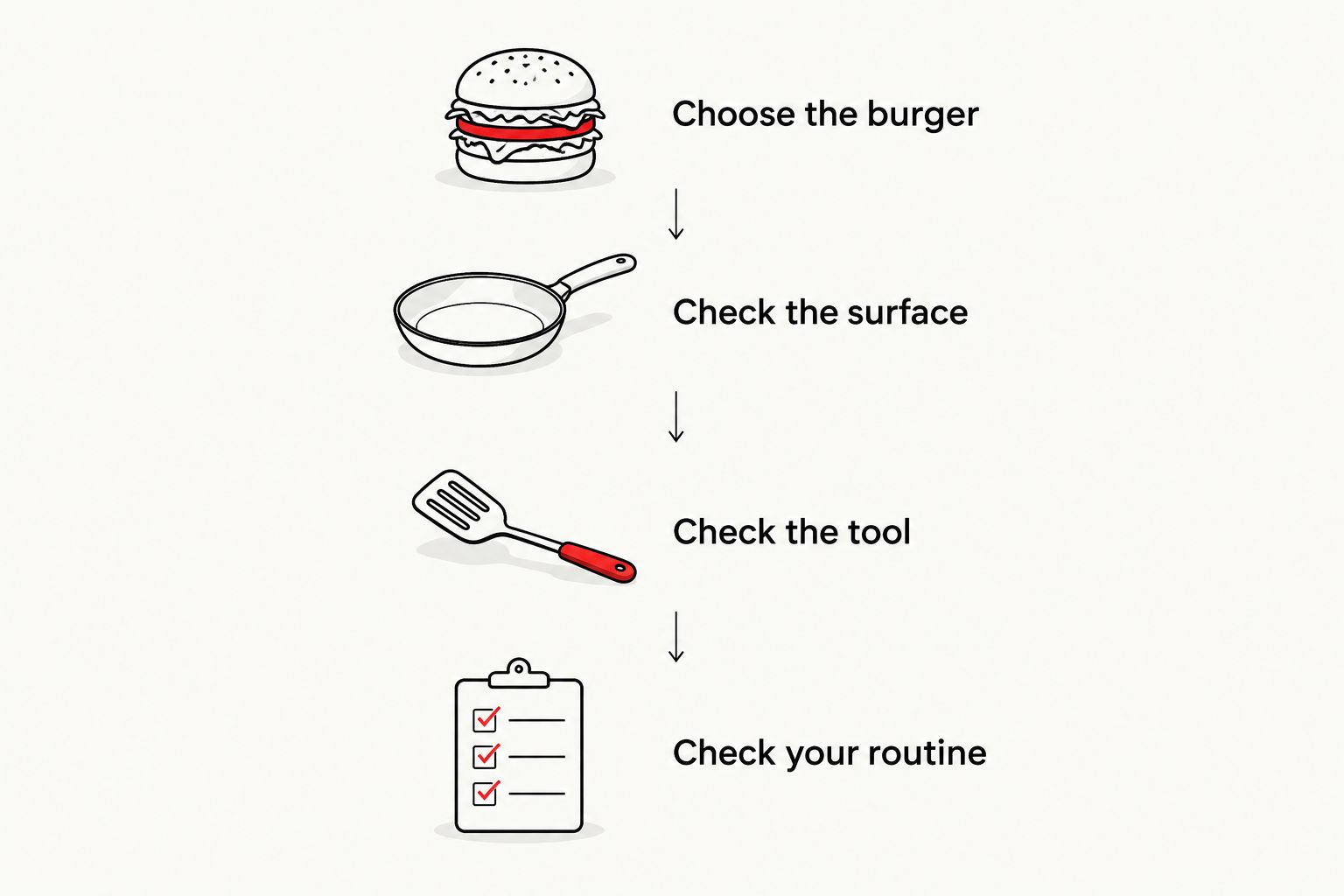
Then do the least glamorous check of all: open the drawer. If you already own something that safely does the job, use it before buying a duplicate. A crowded tool drawer is not a cooking technique.
What neither tool fixes
A press does not replace a suitable cooking surface
A smash press changes the shape of the meat. It does not turn open grates into a flat top, supply missing cooking space, or make unsuitable cookware suitable.
Check the cookware first, particularly if it has a coating or specific utensil restrictions. The fact that a press is made for burgers does not establish compatibility with every pan or griddle.
A mold does not portion meat automatically
A cavity gives you a shape, but you still control how much meat goes into it. Filling the same mold differently produces different patties.
If consistency matters, portion the meat consistently before shaping. Otherwise, you are asking the mold to correct a difference you put into it. Matching circles are not necessarily matching thicknesses.
Repeated pressing is not the goal
Smash-burger cooking uses an early flattening step to establish the patty’s shape and surface contact. It is not a standing invitation to squeeze the burger throughout cooking.
Pressing later pushes juices out of cooking meat. Shape deliberately, let the burger cook, and handle it with a purpose rather than treating the press like a stress toy.
Neither tool measures doneness
Color, crust, and patty shape do not establish a safe internal temperature. A beautifully browned burger can still need more cooking.
According to USDA food-safety guidance for home cooks, ground beef should reach 160°F internally, measured with a food thermometer. For thin patties, insert the probe from the side so the sensing area reaches the center rather than the hot cookware.
Keep raw-meat prep separate from serving
A patty mold belongs to the raw-meat stage until it has been properly cleaned. A smash press also contacts raw or partly cooked meat, so neither belongs on a clean serving platter between uses.
Set aside a clear resting place for used equipment. Keep prepared raw patties refrigerated until needed, and bring out manageable batches rather than letting the entire cookout’s supply sit beside the grill.
USDA home food-safety guidance calls for washing hands with soap and water for at least 20 seconds before and after handling food. Clean and sanitize food-contact work surfaces after raw-meat preparation, and follow the tool manufacturer’s instructions for the equipment itself. Sanitizing a counter is not the same task as caring for a cast iron tool.
The FDA’s consumer guidance limits unrefrigerated perishable food to 2 hours, reduced to 1 hour above 90°F. That applies to raw burger prep waiting for its turn, not just leftovers after everyone eats.
These rules matter with either tool. A mold makes preparation orderly; it does not make raw meat ready to eat. A press makes meat thinner; it does not certify the center is cooked.
Can a patty mold make smash burgers?
A patty mold can shape meat before cooking, but it does not perform the defining hot-surface smashing step. A preformed thin patty can brown while cooking; that does not make the mold a hot-surface press.
Choose the smash press when you want to spread the meat directly against the cookware. Choose the mold when your priority is shaping beforehand. There is no need to pretend those jobs are identical.
Do you need a patty mold if you already have a smash press?
You need a patty mold only if forming burgers ahead solves a separate problem in your routine. A smash press does not require a mold as a companion purchase.
For a cookout built around on-surface smashing, portioning the meat ahead can be enough preparation. Add a mold because you regularly want formed patties—not because every tool needs a roommate.
Can you smash a burger that was already molded?
You can flatten a preformed patty further on suitable cookware, but molding it first adds a preparation step. That extra step is unnecessary when your intended method starts with a loosely portioned ball of meat.
Decide which workflow you want before starting. Shape ahead for a preformed burger, or portion ahead and smash during cooking; combining both is not automatically an upgrade.
FAQ
What's the difference between a smash burger press and a patty press?
A smash burger press flattens meat directly on a suitable hot cooking surface; a patty press often means a mold that shapes raw meat beforehand. Because sellers use the names inconsistently, check the tool’s intended job.
Which is better for thin burgers, a smash press or a mold?
A smash press is the better match for thin burgers flattened during cooking. A mold suits burgers you want to shape before they reach the heat.
Is the Dead Smash - Burger Press a patty mold?
Dead Meat Society describes the Dead Smash - Burger Press as a heavyweight cast iron smash burger press, not a patty mold. Its intended role is pressing burgers during cooking rather than shaping raw patties inside a cavity.
Can I use a plastic patty mold on a hot griddle?
Do not use a plastic patty mold on a hot griddle unless its manufacturer explicitly permits that use. Being suitable for food preparation does not establish suitability for cooking heat.
Do I need both a smash burger press and a patty mold?
You need both only if you regularly use both cooking workflows. Buy a smash press for on-surface flattening or a mold for repeated prep-ahead shaping; neither requires the other.
What internal temperature should a smashed beef burger reach?
A smashed beef burger should reach 160°F internally under USDA guidance for ground beef. Check with a food thermometer rather than judging safety by crust or color.
One last thing
The most useful distinction is not heavy versus light, round versus square, or fancy versus plain. It is where the meat is when you press it. Before cooking, you are shaping. Against the hot cooking surface, you are smashing.
Use that question whenever a listing gets vague: “Does this form the burger before cooking, or flatten it while cooking?” The answer cuts through the naming mess without a drawer full of experiments. Pick the method. Make the burgers. Feed everyone.

